Imagine you finally launch your premium skincare line. The orders pour in, but your packaging arrives with color shifts, dents, and delays. Your customers complain, and your cash flow suffers.
Choosing the right low MOQ packaging supplier in China helps you test ideas fast without big risks. It gives you premium quality, consistent colors with ΔE under 1[^1], and smooth delivery so you can focus on growth instead of headaches.
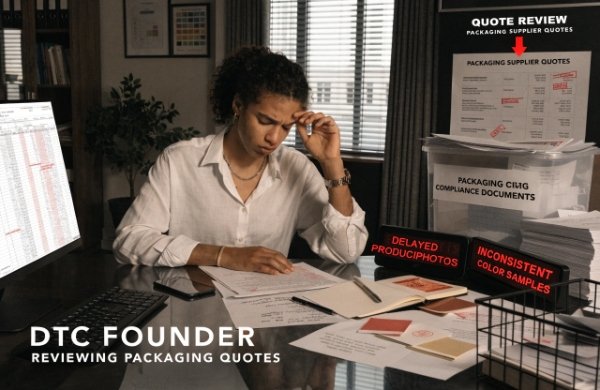 Warning signs of bad packaging suppliers
I have seen many DTC founders face these issues in my work at Chocopackage. This guide shares what to watch for so you can protect your brand.
Why Choosing the Wrong Low MOQ Supplier in China Can Destroy Your Brand and Cash Flow
Bad suppliers create problems that hit your brand hard.
The wrong low MOQ supplier in China can lead to inconsistent colors, late deliveries, poor quality, high return rates, and tied-up capital that hurts your business.
 Brand damage from bad packaging
I remember one founder who chose a cheap supplier for supplement pouches. The colors did not match across batches. Customers thought the product changed, and returns jumped[^2]. This cost thousands and damaged trust.
Many new importers think low MOQ means easy entry. But reality shows big problems. First, color inconsistency destroys premium feel. Your $89 skincare jar needs matching pouches that look just as good. If ΔE exceeds 1, the unboxing experience fails. Customers notice and leave bad reviews.
Second, delivery delays kill launch windows. You plan marketing around a date, but production lags by weeks. Your ads run with no stock. This wastes money on Google Ads and loses momentum.
Third, quality issues like weak materials or bad printing cause damage in shipping. For e-commerce retail shipping, this means more returns and refunds. One client lost 15% of orders due to torn mailers[^3].
Fourth, hidden costs appear. Low prices look good at first, but you pay for rework, extra inspections, or customs fixes. This ties up cash you need for growth.
Fifth, compliance failures hurt. In 2026, EU EPR rules and California SB 54[^4] demand proper sustainable materials. A supplier without FSC or GRS knowledge[^5] leads to fines or blocked shipments.
Sixth, communication breakdowns waste time. Vague replies mean you chase updates instead of building your brand.
To avoid these, check suppliers carefully. Look at their experience with cosmetics personal care or nutraceuticals supplements. Request proof of past work.
I built processes at Chocopackage to fix these exact problems. We start with low MOQs from 500-1000 pieces[^6]. Our color matching keeps consistency high. We share production photos and reports so you see progress.
Use this knowledge to evaluate options. Compare quotes not just on price but on reliability. Ask for references from brands in food beverage or luxury gift packaging.
| Risk | Impact on Brand | How to Spot Early |
|---|---|---|
| Color shifts | Weak premium image | Ask for batch samples |
| Delays | Missed sales | Check past lead times |
| Poor materials | High returns | Request material certs |
| No compliance | Fines or blocks | Verify EU EPR knowledge |
This table shows why you need to dig deep. In my years helping DTC brands, these issues repeat when founders skip checks.
Expand your view to structural design too. Bad suppliers say no to custom die-cut functional packaging. This limits your brand story. At Chocopackage, we offer free structural design and 7-day prototyping.
Our detailed guide on how to prepare print-ready files for custom packaging printing helps you avoid artwork errors that suppliers often blame on you.
Another common trap is ignoring sustainability. Brands face greenwashing risks in 2026[^7]. Choose partners who understand 2026 EU EPR regulations like we do when supporting clients with compliant materials.
We also cover the inventory trap that kills most skincare and supplement launches. Low MOQ helps you dodge it when you work with the right partner.
By understanding these dangers, you gain power to choose better. This protects your cash flow and supports steady growth.
The Most Common Red Flags New Importers Miss When Sourcing Low MOQ Packaging
New importers often overlook early warning signs.
Common red flags include lack of factory proof, slow replies, and vague quality promises. Spotting them early saves you from bigger issues later.
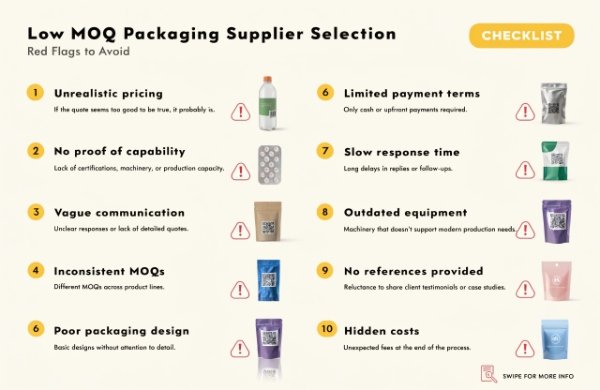
I talk with many founders who learned the hard way. One ignored slow email responses and faced months of production silence.
New importers focus on price and MOQ but miss deeper signals. Lack of transparency about factory ownership tops the list. Many trading companies claim they own factories. Always ask for a video tour or visit. At Chocopackage, we show our partners openly.
Second, unrealistically low prices signal cuts in quality. If quotes beat market rates by much, they often use thinner materials or skip inspections. This hurts your rigid boxes or stand up pouches.
Third, poor communication shows in slow responses. Good suppliers reply within hours with clear details. Vague answers on sampling mean future problems.
Fourth, unwillingness to share samples or reports is a big issue. Real low MOQ suppliers provide physical samples fast. They share material certificates and QC photos.
Fifth, they avoid questions about quality control. Strong partners explain AQL standards[^8] and inspection steps proudly. Evasive talk warns you away.
Sixth, no experience with your market rules leads to trouble. Suppliers who do not know FDA, REACH, or Australian standards[^9] cause customs delays.
Seventh, limited customization options appear. If they push standard designs only, they cannot support your creative needs like magnetic closure boxes or custom labels.
Eighth, no references or case studies. Ask for past clients in cbd packaging or e-commerce retail shipping.
Ninth, unclear lead times and no updates during production.
Tenth, resistance to small test orders or changes.
I use these checks daily. For example, when we work on paper tubes for essential oils, we verify every step.
- Request factory verification videos
- Compare prices to market averages
- Time their response speed
- Demand detailed QC plans
- Check regulatory knowledge
| Red Flag | Good Supplier Behavior | Warning Sign |
|---|---|---|
| Factory proof | Shares video or visit | Claims only |
| Pricing | Fair market rate | Too low |
| Samples | Quick physical samples | Delays or excuses |
| QC process | Detailed explanation | Vague answers |
This structure helps you evaluate fast.
Our article on sample vs mass production and how to make sure they actually match in 2026 shows why consistency matters so much.
Also check our post on magnetic closure boxes: why they fail and how to choose one that won’t break your brand.
For structural needs, see how custom die-cut and functional packaging reinforces your brand story.
These resources from our blog help you avoid the common traps new importers face. In my experience, taking time here prevents months of stress. You build a supply chain that scales with your premium DTC brand.
Sustainability remains key. Read our piece on greenwashing risks in 2026 and how to choose a packaging supplier that won’t get you fined.
By spotting these flags, you save time and money. This lets you focus on what matters: your customers and growth.
10 Critical Red Flags You Must Check Before Working with Any Low MOQ Supplier
You need a clear checklist before you commit.
Here are 10 critical red flags to check with any low MOQ packaging supplier in China to protect your project.
I created this list from real cases I handled at Chocopackage. It helps founders make smart choices.
Red flag 1: No clear factory ownership. Ask for proof. Trading companies often add markups and reduce control.
Red flag 2: Prices too good to be true. They cut corners on materials for folding cartons or custom labels.
Red flag 3: Slow or poor communication. Test with detailed questions. Good partners respond fast in English.
Red flag 4: No sample willingness or high sample fees. Reliable suppliers offer samples to build trust.
Red flag 5: Vague quality control answers. They should share AQL, inspection reports, and photos.
Red flag 6: Lack of market regulation knowledge. They must understand FSC, PCR, and EU EPR for 2026.
Red flag 7: Limited customization. They should support spot UV, embossing[^10], and unique structures.
Red flag 8: No past client references. Request examples from similar industries.
Red flag 9: Unclear timelines and no progress updates. Demand weekly reports.
Red flag 10: Resistance to compliance documents or third-party inspections.
Use this table to score potential suppliers.
| Red Flag Number | Description | Check Method | Safe if... |
|---|---|---|---|
| 1 | Factory ownership | Video call | Shows real facility |
| 2 | Low prices | Market compare | Reasonable rates |
| 3 | Communication | Inquiry test | Fast clear replies |
| 4 | Samples | Request | Provides quickly |
| 5 | QC process | Ask details | Explains standards |
| 6 | Regulations | Specific questions | Knows EU EPR etc. |
| 7 | Customization | Design request | Offers options |
| 8 | References | Ask for contacts | Shares examples |
| 9 | Timelines | Timeline ask | Clear and met |
| 10 | Compliance | Cert requests | Provides docs |
This checklist guides your talks. I apply it with every new partner.
For example, with nutraceuticals supplements clients, we focus on child-resistant features[^11] and labels.
Explore our custom printed paper tubes with lock-on lid for secure CBD and essential oils packaging when you need reliable options.
Also, learn how to make your supplement pouches look as premium as your $89 skincare jar.
For boxes, see our solutions for custom paper packaging boxes that are sustainable and versatile.
Our blog has more on 2026 unboxing trends that make premium DTC customers say “wow”.
And insights into structural packaging innovation for premium DTC in 2026.
These 10 flags cover the main dangers. Checking them helps you find a partner who supports your vision. In practice, this process takes time but saves much more later. You avoid the inventory trap and build lasting success.
How Choco Package Avoids These Red Flags and Delivers Reliable Low MOQ Packaging
We built our service to solve these exact problems.
Choco Package avoids red flags through transparency, quality control, and strong support for low MOQ orders.
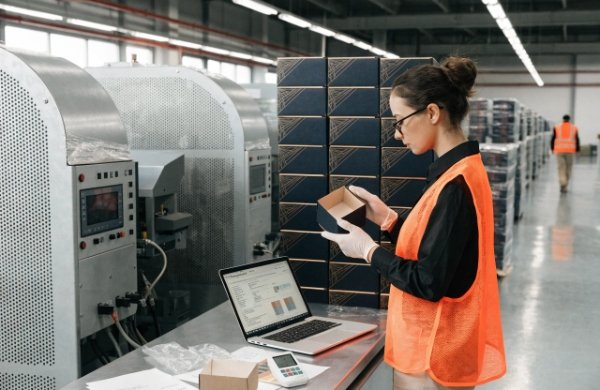 Choco Package reliable packaging
As product manager, I make sure every client gets reliable service.
At Chocopackage, we own our processes. We work with verified factories in Xiamen. You can request video verification anytime. This removes ownership doubts.
We keep prices fair. No unrealistic lows that hide quality cuts. Our rigid boxes, folding cartons, and stand up pouches use premium materials with ΔE under 1 consistency.
Communication is fast. I or my team reply quickly with clear updates. We use English and share production photos weekly.
We provide samples fast, often within 7 days. You review before mass production. This matches sample to mass as explained in our guide.
Our QC is transparent. We follow AQL standards and share full reports. No vague answers.
We know regulations well. We help with FSC, GRS, EU EPR, and more. This protects you from fines in 2026.
Customization is our strength. We offer free structural design, dielines, embossing, and more. No limits on your ideas.
We share references gladly. Many DTC brands in cosmetics and wellness work with us.
Timelines are clear and met. We track every step.
Compliance documents come standard.
This table shows our edge.
| Area | Our Approach | Benefit to You |
|---|---|---|
| MOQ | 500-1000 pcs | Test without risk |
| Quality | ΔE <1, QC reports | Premium consistency |
| Delivery | DDP global | No surprises |
| Support | Dedicated manager | Fast help |
We support cosmetics personal care, nutraceuticals supplements, food beverage, luxury gift packaging, cbd packaging, and more.
Visit our about page to learn our story.
I personally review artwork files for clients. This prevents errors. Contact me to start.
By choosing us, you get a true partner. We act as risk mitigator, brand guardian, compliance architect, and end-to-end orchestrator. This lets you scale confidently.
Ready to Find a Safe and Reliable Low MOQ Packaging Partner? Here’s Your Next Step
You now know the red flags and solutions.
Take action today by reaching out to a trusted partner like Choco Package for a free consultation and sample review.
 Next steps with reliable partner
I am ready to help you evaluate options and start strong.
First, visit our site and review your needs. Send your dieline or artwork. I will check it personally.
Second, book a call. We discuss your product category whether skincare or supplements.
Third, request samples. Test our quality with low MOQ.
Fourth, compare using the checklist above.
Fifth, plan your launch with our support.
We offer door-to-door DDP delivery and clear English support.
Read more on our blog for ongoing tips.
Contact us via contact page.
This step moves you from worry to confidence. Many brands we helped now scale successfully. You can too.
Conclusion
Choosing a low MOQ packaging supplier in China can be one of the most important decisions for your brand’s success — or failure. While low minimum order quantities offer flexibility and lower risk for testing new products, they also come with hidden dangers if you don’t know what to look for. By staying alert to these 10 red flags and working with a transparent, experienced partner, you can avoid costly mistakes and build a reliable supply chain that supports your growth. Don’t let a bad supplier choice hold your brand back. Take the time to evaluate carefully — your products and customers deserve the best.
🛠️ Why Work With Chocopackage?
As the Strategic Packaging Partner for Scaling Premium DTC Brands, Chocopackage helps high-growth skincare, supplement, wellness, and luxury brands turn their vision into reality. From startups to established DTC leaders, we deliver:
- 📦 Premium rigid boxes, folding cartons, stand-up pouches & custom labels
- 🧑🎨 Free structural design, dielines & 7-day rapid prototyping
- ✅ Ultra-low MOQs starting at 500–1,000 pcs
- 🚚 Reliable door-to-door DDP global delivery[^12]
- 💬 Fast, clear English communication & dedicated support
📩 Need help checking your artwork file or reviewing a dieline?
Just send it over — I’ll personally review it and guide you every step of the way.
- 🌐 Website: https://chocopackage.com/
- ✉️ Email: lily@chocopackage.com
- 📱 Call / WhatsApp: +86 134 5929 7861
[^1]: "Delta E | PrintPlanet.com", https://printplanet.com/threads/delta-e.246017/. Delta E (ΔE) quantifies color difference in the CIE color space, where values below 1.0 are generally considered imperceptible to the human eye under standard viewing conditions, making this threshold relevant for quality control in color-critical applications like packaging. Evidence role: definition; source type: encyclopedia. Supports: ΔE (Delta E) is a standardized metric for measuring color difference in the CIE color space. Scope note: The specific threshold for 'imperceptible' color difference varies by industry standard and viewing conditions
[^2]: "Product Packaging by E-commerce Platforms: Impact of COVID-19 ...", https://pmc.ncbi.nlm.nih.gov/articles/PMC9685062/. Research on consumer behavior indicates that packaging quality affects brand perception and customer satisfaction, which are factors associated with return behavior, though the specific impact of color inconsistency on return rates depends on product category and customer expectations. Evidence role: general_support; source type: research. Supports: Packaging quality and consistency influence consumer perception and satisfaction in e-commerce contexts. Scope note: Direct causal evidence linking packaging color variation to measurable increases in return rates is limited in published research
[^3]: "Minimize Shipping Damage in Your Ecommerce Deliveries", https://www.ecoenclose.com/blog/minimize-shipping-damage-in-your-ecommerce-deliveries/?srsltid=AfmBOopOLfvW8L2YPbI40uqL5-oLZBzGeyuPFb0WLS9uZepKO_wK7N7r. Studies of e-commerce logistics indicate that packaging-related damage during shipping affects order fulfillment costs and customer satisfaction, with damage rates varying significantly based on packaging quality, product type, and shipping methods, though specific loss percentages depend on individual operational factors. Evidence role: general_support; source type: research. Supports: Packaging damage during shipping represents a measurable cost factor in e-commerce operations. Scope note: The cited 15% figure appears to be a specific case example rather than an industry average
[^4]: "SB 54: Plastic Pollution Prevention and Packaging Producer ...", https://calrecycle.ca.gov/packaging/packaging-epr/. Extended Producer Responsibility (EPR) frameworks in the European Union and California's SB 54 (Plastic Pollution Prevention and Packaging Producer Responsibility Act) impose obligations on producers regarding packaging waste management and material choices, though specific implementation dates and requirements vary by jurisdiction. Evidence role: general_support; source type: government. Supports: Extended Producer Responsibility (EPR) regulations in the EU and California SB 54 establish requirements for packaging materials and producer responsibilities. Scope note: The article's claim about 2026 timing requires verification against current regulatory schedules, as implementation phases differ across regions
[^5]: "Paper & Packaging | Forest Stewardship Council", https://fsc.org/en/businesses/paper-packaging. The Forest Stewardship Council (FSC) certifies responsibly sourced forest products including paper and paperboard, while the Global Recycled Standard (GRS) verifies recycled content and responsible production practices, both serving as third-party verification systems for sustainable packaging materials. Evidence role: definition; source type: institution. Supports: FSC and GRS are internationally recognized certification systems for sustainable materials.
[^6]: "Minimum Order Quantity: What Is It and Why Does It Matter", https://www.paramountglobal.com/knowledge/minimum-order-quantity/. Minimum order quantities in custom packaging manufacturing typically range from hundreds to tens of thousands of units depending on production method, material type, and customization complexity, with digital printing and flexible manufacturing enabling lower MOQs than traditional offset printing or tooling-intensive processes. Evidence role: general_support; source type: other. Supports: MOQ ranges vary significantly in the packaging industry based on production methods and customization. Scope note: What constitutes 'low' MOQ is relative to production method and industry segment rather than an absolute threshold
[^7]: "Green Guides | Federal Trade Commission", https://www.ftc.gov/news-events/topics/truth-advertising/green-guides. Regulatory bodies including the European Commission and the U.S. Federal Trade Commission have been strengthening enforcement and developing new frameworks for substantiating environmental marketing claims, with various initiatives targeting greenwashing scheduled for implementation in the mid-2020s, though specific timelines vary by jurisdiction. Evidence role: general_support; source type: government. Supports: Regulatory scrutiny of environmental claims in marketing is increasing. Scope note: The specific significance of 2026 as a threshold year for greenwashing risk requires verification against current regulatory schedules
[^8]: "[PDF] ISO 2859-1 - UNT Chemistry", https://chemistry.unt.edu/~tgolden/courses/iso2859-1.pdf. Acceptable Quality Limit (AQL) is a statistical sampling methodology defined in ISO 2859 standards, used in manufacturing to determine acceptable defect rates through batch inspection, with applications across industries including packaging production. Evidence role: definition; source type: institution. Supports: AQL (Acceptable Quality Limit) is a standardized statistical sampling method for quality inspection.
[^9]: "Food Packaging & Other Substances that Come in Contact with Food", https://www.fda.gov/food/food-ingredients-packaging/food-packaging-other-substances-come-contact-food-information-consumers. The U.S. Food and Drug Administration (FDA) regulates food-contact materials, the EU's REACH (Registration, Evaluation, Authorisation and Restriction of Chemicals) regulation addresses chemical safety in products including packaging, and Australia maintains its own packaging and labeling standards, each imposing distinct compliance requirements on packaging suppliers serving those markets. Evidence role: general_support; source type: government. Supports: Multiple regulatory frameworks govern packaging materials in different markets.
[^10]: "Spot UV Printing Guide: Coating & Finishes for Packaging - Gentlever", https://gentlever.com/spot-uv-for-custom-packaging/. Spot UV (ultraviolet) coating applies a glossy, raised finish to selected areas of printed materials, while embossing creates raised three-dimensional designs through mechanical pressure and dies; both are finishing techniques used in premium packaging to add tactile and visual interest. Evidence role: definition; source type: encyclopedia. Supports: Spot UV and embossing are post-printing finishing techniques used in packaging.
[^11]: "16 CFR Part 1700 -- Poison Prevention Packaging - eCFR", https://www.ecfr.gov/current/title-16/chapter-II/subchapter-E/part-1700. The U.S. Consumer Product Safety Commission (CPSC) enforces the Poison Prevention Packaging Act, which mandates child-resistant packaging for specific substances including certain medications and supplements containing iron, though requirements vary by product formulation and concentration levels. Evidence role: general_support; source type: government. Supports: Child-resistant packaging is required for certain categories of products that pose ingestion risks. Scope note: Not all nutraceutical supplements require child-resistant packaging; requirements depend on specific ingredients and regulatory classification
[^12]: "Know Your Incoterms - International Trade Administration", https://www.trade.gov/know-your-incoterms. Delivered Duty Paid (DDP) is an Incoterms® 2020 trade term in which the seller assumes maximum responsibility, including delivery to the buyer's specified destination, payment of all duties and taxes, and bearing all risks until goods are ready for unloading, making it the most comprehensive delivery service from the buyer's perspective. Evidence role: definition; source type: institution. Supports: DDP is a standardized international trade term defining delivery responsibilities.