Three months ago, a skincare brand founder came to us with what seemed like a straightforward request: source eco-friendly gift boxes for their Amazon launch. They had beautiful designs ready and a tight timeline. Then Amazon's compliance team rejected their listing[^1]. The reason? Missing FSC certification documentation. Their launch delayed by six weeks while they scrambled to find a certified supplier and restart production.
Verified sustainability certifications are no longer optional marketing badges — they are channel gatekeepers that determine whether your product gets listed, stays compliant, and reaches customers. Brands that treat certifications as afterthoughts face rejected SKUs, delisted products, and missed launch windows.
 Verified sustainability certifications documentation
I see this pattern repeat every week in our client onboarding process. Founders contact us urgently because a retailer, marketplace, or regulatory body is blocking their product. They assumed their packaging was "good enough" because it looked sustainable or their previous supplier mentioned certifications vaguely. But when channels ask for audit trails, chain-of-custody numbers, or compliance reports, the problems surface.
What Actually Triggers Brands to Seek Certified Packaging?
Most brands don't wake up one morning thinking about packaging certifications. They come to us at two specific pain points. The first happens post-design, when they've already invested in product development and marketing assets. A channel partner sends a compliance checklist asking for FSC chain-of-custody certificates[^2], GRS transaction numbers, or EPR registration proof. Suddenly they realize their current supplier can't provide documentation, and they're facing a choice: delay the launch or lose the channel opportunity.
The second trigger happens during supplier selection, when operations teams try to de-risk future growth. They've seen competitors get delisted or heard cautionary stories from industry peers. They want packaging that clears Amazon's sustainability requirements, satisfies Sephora's packaging audits, and stays compliant as EU regulations tighten.
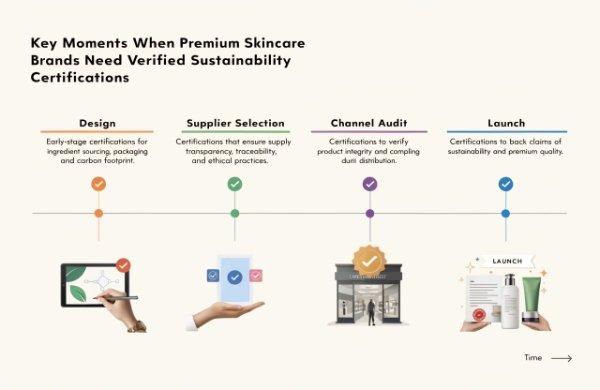 Premium brand packaging certification timeline
I remember a wellness brand that switched to us after their previous supplier claimed to be "FSC-compliant." When Whole Foods requested their FSC certificate number during a routine audit, the supplier admitted they had FSC materials but no chain-of-custody certification. That distinction cost the brand a three-month retailer relationship pause and emergency repackaging of 8,000 units already in warehouse storage. The financial hit was significant, but the damaged retailer relationship was harder to repair.
Which Certifications Do Different Channels Actually Enforce?
Brands often treat FSC as a universal solution, assuming one certificate satisfies all requirements. That assumption creates problems because channels and regions have distinct verification standards. Amazon's sustainability certification program accepts FSC-COC as baseline documentation for paper-based packaging, and they verify it through their Brand Registry system. But Sephora's packaging requirements go further, requiring supplier declarations that confirm post-consumer recycled content percentages and material traceability beyond basic FSC compliance.
Target and Walmart have introduced How2Recycle labeling requirements[^3] for shelf-ready packaging, which means brands need clear disposal instructions that align with regional recycling infrastructure. This isn't about having recyclable materials. It's about proving your packaging qualifies for the specific recycling streams available in the markets where you sell. A box that's recyclable in California might not meet infrastructure standards in Texas or Florida.
European retailers operate under entirely different enforcement systems. EU Extended Producer Responsibility laws[^4] require brands to register with national packaging compliance schemes before they can legally sell. France's AGEC law mandates Triman recycling symbols[^5] and material disclosure on consumer packaging. Germany's VerpackG system requires brands to contract with a dual system operator[^6] and report packaging weights quarterly.
| Channel Type | Primary Certification | Verification Method | Consequence of Non-Compliance |
|---|---|---|---|
| Amazon (US) | FSC-COC | Upload certificate to Brand Registry | Listing suppression or removal |
| Sephora | FSC + Supplier Declaration | Periodic audit requests | Account review or delisting |
| Whole Foods | FSC + How2Recycle | Supplier portal submission | Rejected purchase orders |
| EU Retailers | EPR Registration + Triman | National compliance database | Import blocks and fines |
| Australian Retailers | APCO Membership | Annual reporting | Non-compliance penalties |
I've seen brands lose entire European expansion plans because they didn't budget for EPR registration costs or understand that each EU country requires separate compliance. One cosmetics brand spent four months preparing for a UK launch through a major beauty retailer, only to discover their packaging supplier couldn't provide the UK-specific OPRL recycling labels the retailer required. They had FSC certification and thought that covered sustainability requirements. It didn't. They had to redesign packaging, re-run production, and push their launch to the next retail cycle.
How Do Mandatory Requirements Differ from Competitive Differentiators?
The biggest confusion I encounter is brands mixing up mandatory compliance with optional marketing claims. FSC certification is mandatory if you want to sell through Amazon, Target, or Whole Foods[^7] — it's the entry ticket, not the competitive advantage. Brands that position FSC as a premium feature misunderstand the current market landscape. FSC has become table stakes for premium brands because channels won't list unverified products.
GRS (Global Recycled Standard) certification[^8] is moving in the same direction, especially for brands using post-consumer recycled materials. Sephora and Ulta increasingly audit recycled content claims because greenwashing accusations create legal and reputational risks for retailers. If your packaging claims "made with recycled materials" but you can't produce GRS transaction certificates linking your supplier's materials to verified recycling streams, retailers may flag your products for compliance review.
EPR registration is legally mandatory in the EU, Australia, and increasingly in U.S. states like California and Colorado. This isn't a certification you choose for marketing purposes. It's a legal requirement to sell packaged goods. Brands that skip EPR registration face import blocks, fines, and in some cases, retailer contract termination.
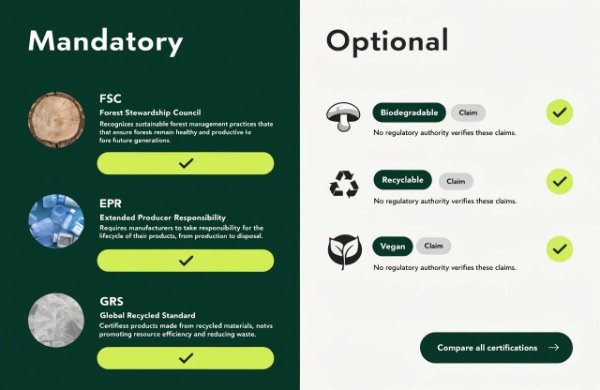 Mandatory vs optional sustainability certifications
Carbon neutrality claims and biodegradability certifications fall into optional differentiator territory for now. Brands can pursue these to strengthen positioning, but channels don't gate access based on carbon labels yet. However, this landscape shifts rapidly. California's SB 343 Truth in Labeling law now restricts which products can use the "chasing arrows" recycling symbol[^9], effectively making certain recyclability claims regulated rather than optional.
I worked with a supplement brand that learned this distinction the hard way. They invested in a custom compostable mailer certified by BPI (Biodegradable Products Institute)[^10], expecting it to open doors with sustainability-focused retailers. But when they approached partners, the first question was always "Do you have FSC for your product boxes?" The compostable mailer was impressive but irrelevant to the compliance checklist retailers used for onboarding. They ended up needing both certifications, not as an either-or choice.
What Documentation Do Audits Actually Request?
Channel audits don't just verify that your supplier has certifications hanging on their office wall. They request transaction-specific documentation that proves your particular production run used certified materials and followed chain-of-custody protocols. For FSC, this means providing an FSC certificate number, the certificate holder's name, and a sales invoice showing FSC claim codes that match your product specifications. Generic supplier certifications don't satisfy audits — brands need order-level traceability.
GRS audits request transaction certificates that link your packaging order to specific recycled material batches. These certificates include recycled content percentages, material sources, and processing facility information. Without transaction certificates, brands can't substantiate recycled content claims, even if their supplier is GRS-certified. The certification applies to the facility's capability, but the transaction certificate proves your specific order used verified materials.
EU EPR compliance requires quarterly or annual reporting of packaging weights, materials, and sales volumes. Brands must maintain records showing what packaging entered each EU market and in what quantities. Retailers may request proof of EPR registration during onboarding or routine audits, and customs authorities can block shipments if brands lack proper registration.
| Certification | Required Documentation | Typical Audit Request | Update Frequency |
|---|---|---|---|
| FSC-COC | Certificate + Invoice with FSC codes | Certificate number and expiration date | Every 5 years (renewal) |
| GRS | Transaction Certificate | Batch-specific material traceability | Per production order |
| EPR (EU) | Registration Number + Annual Report | Country-specific registration proof | Annual reporting |
| How2Recycle | License Agreement + Label Approval | Approved label artwork | Per SKU design |
I recently helped a brand prepare for a Sephora packaging audit after they received a routine compliance notice. They panicked because their previous supplier had provided a generic FSC certificate that didn't include their company name or specific product details. We had to trace back through their supply chain, confirm which production batches used FSC materials, and compile invoices that documented the chain of custody. The process took two weeks of back-and-forth communication and could have been avoided if they'd requested proper documentation upfront.
How Should Brands Approach Supplier Selection to Reduce Compliance Risk?
The most effective way to avoid compliance problems is choosing suppliers whose certifications align with your target channels and markets before you commit to production. This means mapping your expansion plans against certification requirements and qualifying suppliers based on verified credentials, not marketing claims. When evaluating packaging suppliers, I recommend brands request current certificate copies, not just statements that a supplier is "certified."
Look for suppliers who can provide transaction-level documentation, not just facility certifications. A supplier with FSC-COC certification should be able to issue invoices with FSC claim codes and provide separate transaction certificates for GRS orders. If they hesitate or say "we'll handle that later," consider it a red flag. Compliance documentation should be standard procedure, not an accommodation.
Ask suppliers which specific channels and markets their certifications cover. FSC certification is globally recognized, but EPR registration is country-specific. A supplier experienced in EU markets should have established relationships with compliance schemes and understand PPWR (Packaging and Packaging Waste Regulation)[^11] timelines. Suppliers focused only on U.S. e-commerce may lack the infrastructure to support European expansion.
 Packaging supplier certification verification
I've noticed brands often skip the verification step during initial supplier conversations, assuming certifications are universal or that all suppliers interpret requirements similarly. One DTC brand selected a supplier based on competitive pricing and lead times, only discovering three months into their relationship that the supplier's FSC certificate didn't cover the specific paperboard grade they were using. They had to either switch materials and redesign packaging or find a new supplier. Both options created delays they couldn't afford during their funding runway.
What Are the Cost and Timeline Realities of Obtaining Certifications?
Brands frequently underestimate both the time and investment required to implement verified certifications across their supply chain. FSC chain-of-custody certification for a packaging supplier typically requires 3-4 months from application to approval[^12], including documentation preparation, on-site audits, and certification body review. If your supplier isn't already certified and you need FSC for a channel launch, you're looking at significant timeline buffer.
GRS certification involves even longer timelines because it requires full supply chain verification, from raw material recyclers through final product manufacturers. The process can take 4-6 months and requires coordination among multiple parties in the supply chain. For brands needing GRS transaction certificates for an upcoming launch, working with an already-certified supplier is the only realistic option on compressed timelines.
EPR registration timelines vary by country but generally require 2-8 weeks for initial approval. However, brands must complete registration before importing products, not after sales begin. This means factoring EPR into market entry planning, not treating it as a post-launch administrative task.
| Certification | Application Timeline | Audit Requirements | Typical Cost Range (Supplier-Side) |
|---|---|---|---|
| FSC-COC | 3-4 months | On-site facility audit | $2,000-5,000 annually |
| GRS | 4-6 months | Full supply chain audit | $3,000-8,000 annually |
| EPR (per EU country) | 2-8 weeks | Documentation review | €500-2,000 annually |
| How2Recycle (Licensing) | 2-4 weeks | Label design review | $500-2,000 per SKU |
I worked with an emerging clean beauty brand that needed FSC certification for a Target partnership. They approached suppliers assuming certification was a quick paperwork exercise. When they learned the actual timeline, they had to choose between delaying their Target launch by a quarter or working with a more expensive supplier who was already FSC-certified. They chose the certified supplier, paid a 15% premium on packaging costs, but made their launch window. The premium was frustrating but far cheaper than missing the holiday retail cycle.
Conclusion
Verified sustainability certifications have evolved from optional marketing tools into mandatory compliance requirements that control channel access, market entry, and regulatory approval. Brands that understand which certifications their channels enforce, what documentation audits require, and how to qualify suppliers accordingly will avoid the costly delays and rejected listings that plague unprepared competitors.
[^1]: "Amazon Brand Registry", https://sell.amazon.com/brand-registry. Amazon's Brand Registry system includes sustainability certification verification processes that can affect listing approval, though specific enforcement practices may vary by product category and marketplace region. Evidence role: general_support; source type: other. Supports: Amazon's enforcement of sustainability certifications for product listings. Scope note: Official Amazon seller documentation would confirm the specific certification requirements and enforcement mechanisms described
[^2]: "[PDF] Group Chain of Custody (CoC) FSC Certification Manual", https://cfwc.mgcafe.uky.edu/sites/cfwc.ca.uky.edu/files/cfwc_coc_group_certification_manual_revised_2_16_2018_0.pdf. FSC chain-of-custody (COC) certification verifies that FSC-certified material is identified and separated from non-certified material throughout the supply chain, from forest to final product, as defined by the Forest Stewardship Council's international standards. Evidence role: definition; source type: institution. Supports: The definition and purpose of FSC chain-of-custody certification.
[^3]: "How2Recycle: Home Page", https://how2recycle.info/. How2Recycle is a standardized labeling system created by the Sustainable Packaging Coalition that provides consistent disposal instructions based on Federal Trade Commission Green Guides and access to recycling infrastructure across different U.S. regions. Evidence role: definition; source type: institution. Supports: The How2Recycle labeling system and its standards. Scope note: Label recommendations reflect current recycling infrastructure availability, which varies by municipality
[^4]: "Packaging and packaging waste directive - Wikipedia", https://en.wikipedia.org/wiki/Packaging_and_packaging_waste_directive. The European Union's packaging waste directives establish Extended Producer Responsibility schemes requiring producers to take responsibility for the collection, sorting, and recycling of packaging waste, with implementation varying by member state. Evidence role: general_support; source type: government. Supports: The existence and requirements of EU Extended Producer Responsibility regulations for packaging. Scope note: Specific registration requirements and enforcement mechanisms differ across EU member states
[^5]: "The Triman Logo: Obligations for e-commerce in France - ecosistant", https://www.ecosistant.eu/en/triman-logo/. France's Anti-Waste for a Circular Economy Law (AGEC) introduced mandatory sorting information and Triman symbols on consumer packaging to improve waste sorting and recycling, with implementation phases beginning in 2021. Evidence role: general_support; source type: government. Supports: French AGEC law requirements for packaging labeling. Scope note: Specific technical requirements and exemptions are detailed in implementing decrees
[^6]: "[PDF] Changes to Germany's Packaging Laws – An Exporter's Guide", https://apps.fas.usda.gov/newgainapi/api/Report/DownloadReportByFileName?fileName=Changes%20to%20Germany%E2%80%99s%20Packaging%20Laws%20%E2%80%93%20An%20Exporter%E2%80%99s%20Guide_Berlin_Germany_8-2-2019. Germany's Packaging Act (VerpackG) requires producers placing packaged goods on the German market to register with the Central Agency Packaging Register (LUCID) and participate in a dual system for collection and recycling of packaging waste. Evidence role: general_support; source type: government. Supports: German Packaging Act requirements for producer registration. Scope note: Specific reporting requirements and thresholds are subject to regulatory updates
[^7]: "Forest Products Policy", https://corporate.target.com/sustainability-governance/responsible-resource-use/environmental-impact-products/forest-products-policy. Large retailers including Target and Whole Foods have established supplier sustainability standards that increasingly include FSC certification preferences or requirements for paper-based packaging, though specific mandates vary by product category and supplier agreements. Evidence role: general_support; source type: other. Supports: Major retailers' sustainability certification requirements for suppliers. Scope note: Individual retailer requirements may vary by product category, supplier tier, and evolve over time
[^8]: "What is the Global Recycled Standard (GRS)? - Textile Exchange", https://textileexchange.org/faq/what-is-the-global-recycled-standard-grs/. The Global Recycled Standard, administered by Textile Exchange, is an international certification that verifies recycled content in products and tracks materials from source to final product, covering processing, manufacturing, and chain of custody requirements. Evidence role: definition; source type: institution. Supports: The definition and scope of GRS certification. Scope note: While originally developed for textiles, GRS has expanded to other product categories
[^9]: "SB 343: Accurate Recycling Labels - CalRecycle Home Page - CA.gov", https://calrecycle.ca.gov/wcs/recyclinglabels/. California Senate Bill 343 (2021) established truth-in-labeling standards that restrict the use of the chasing arrows recycling symbol and recyclability claims to materials that meet statewide recyclability criteria, with enforcement beginning in 2024. Evidence role: general_support; source type: government. Supports: California's restrictions on recyclability labeling. Scope note: Implementation details and enforcement mechanisms continue to evolve through regulatory guidance
[^10]: "BPI - Certified Compostable", https://bpiworld.org/. The Biodegradable Products Institute certifies products and packaging that meet ASTM standards for compostability in industrial composting facilities, verifying that materials will break down in specific timeframes under controlled conditions. Evidence role: definition; source type: institution. Supports: BPI's role in certifying compostable products. Scope note: BPI certification applies to industrial composting and does not guarantee home compostability or biodegradability in all environments
[^11]: "Packaging waste - Environment - European Commission", https://environment.ec.europa.eu/topics/waste-and-recycling/packaging-waste_en. The European Commission's proposed Packaging and Packaging Waste Regulation (PPWR) aims to harmonize packaging requirements across EU member states with targets for recyclability, recycled content, and waste reduction, though specific provisions remain subject to legislative approval. Evidence role: general_support; source type: government. Supports: The EU's Packaging and Packaging Waste Regulation framework. Scope note: As of the article's context, PPWR was in proposal stage with implementation timelines subject to final legislative adoption
[^12]: "[PDF] Group Chain of Custody (CoC) FSC Certification Manual", https://cfwc.mgcafe.uky.edu/sites/cfwc.ca.uky.edu/files/cfwc_coc_group_certification_manual_revised_2_16_2018_0.pdf. FSC chain-of-custody certification involves documentation preparation, on-site audits, and certification body review, with timelines varying based on organization size, supply chain complexity, and certification body scheduling, typically ranging from several weeks to several months. Evidence role: general_support; source type: institution. Supports: Typical timeline for FSC chain-of-custody certification. Scope note: Actual certification timelines vary significantly based on applicant preparedness, audit scheduling, and corrective action requirements