Most founders think choosing a packaging supplier is like buying software. You pick the best option, sign the contract, and forget about it. But I've watched this assumption destroy brands. The supplier who seemed perfect at 1,000 units became a disaster at 10,000.[^1] The "partnership" turned into a nightmare when the founder needed support most.
The real secret is treating your packaging relationship like a marriage, not a purchase order[^2]. You need deliberate check-ins, honest conversations, and the courage to walk away when the fit breaks down. The suppliers who scale with you are the ones you actively manage, not the ones you passively rely on.
 Packaging partnership strategy discussion
This isn't about finding the "perfect" supplier. It's about building a relationship that bends without breaking as your brand evolves.
What Makes Most Packaging Partnerships Fail Within 18 Months[^3]?
Brands fail at packaging partnerships because they treat selection like a one-time event. They run an RFQ, compare quotes, pick the lowest price, and move on. Then 12 months later, they're scrambling to find a replacement after a quality disaster or missed launch window.
The failure happens because brands make four false assumptions: that the supplier who quotes lowest will stay viable, that signed contracts guarantee improvement, that big factories will prioritize your small orders, and that initial fit predicts long-term fit. None of these hold up when your order volume doubles or your product line explodes.
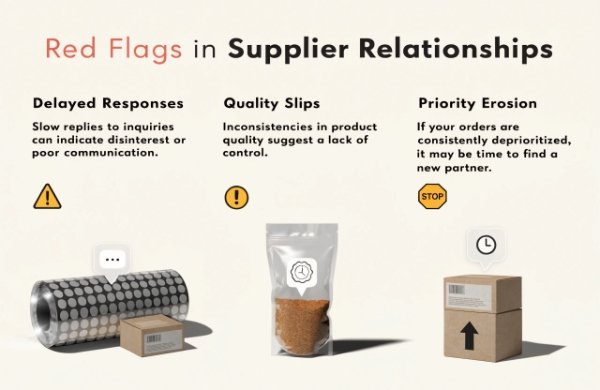 Warning signs in supplier relationships
In the partnerships I've managed at Chocopackage, I've seen this pattern repeat. A brand launches with a supplier who handles 500-unit test runs beautifully. Six months later, they need 5,000 units per month across three SKUs. The supplier's lead times balloon from 3 weeks to 8 weeks. Quality consistency drops. Response times slow from hours to days. The brand is trapped because switching suppliers mid-growth means 2-3 months of inventory disruption.
The real problem is treating partnership like a vending machine. You put in money, you get boxes. But packaging supply chains are fragile systems. They need active management, not passive consumption. When brands ignore early warning signals—like slowing communication or small quality slips—they end up facing catastrophic failures at the worst possible moment.
I worked with a wellness brand that ignored these signals. Their supplier started missing color-match standards by small margins. The brand accepted it because they were busy with a retail expansion. Three months later, a major order shipped with boxes 30% off-brand color. The retailer rejected the entire shipment. The brand lost $40,000 and their shelf space[^4].
Here's what actually breaks partnerships:
| Failure Point | What It Looks Like | Why Brands Miss It |
|---|---|---|
| Volume mismatch | Supplier perfect at 1,000 units struggles at 10,000 | Brands assume factories scale linearly |
| Priority erosion | Response time degrades as you grow | You're still "small" to them despite your growth |
| Capability gap | Can't handle new finishes or structures you need | Initial scope was narrow, new needs weren't discussed |
| Process rigidity | Won't adapt timelines for your launch windows | They optimized for their efficiency, not your calendar |
The partnerships that survive are the ones where both sides treat the relationship as something that needs active maintenance. That means scheduled alignment meetings, transparent escalation protocols, and honest conversations about capacity limits before they become crises.
Why Does Your "Perfect" Supplier Stop Working When You Scale?
Suppliers are not infinitely elastic. A factory optimized for fast sampling and low MOQs is built differently than one optimized for high-volume production[^5]. The capabilities that made them perfect at 1,000 units become liabilities at 10,000 units.
This mismatch happens because different growth stages need different supplier strengths. Early-stage brands need speed and flexibility. Scaling brands need consistency and capacity. Mature brands need cost efficiency and global logistics. One supplier rarely excels at all three stages.
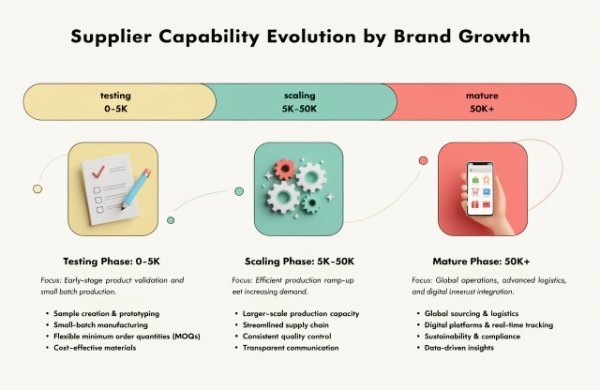 Supplier capabilities across growth stages
I've managed this transition from both sides. When a brand I worked with went from 2,000 units per month to 15,000 units in four months, their supplier couldn't adjust. The factory's quality control was built for small batches with visual inspection. At higher volumes, they needed automated color-matching systems. They didn't have them. Batch-to-batch color variance jumped from ΔE < 2 to ΔE > 5[^6]. The brand's premium positioning collapsed when customers posted comparison photos online.
The deeper issue is that suppliers build infrastructure for specific order profiles. A supplier geared for rapid prototyping invests in small-run equipment and design staff. A supplier geared for volume production invests in automated lines and inventory systems. You can't flip a switch and transform one into the other.
Here's how supplier capabilities map to brand growth stages:
| Growth Stage | What You Need | Supplier Type | Red Flags |
|---|---|---|---|
| Testing (0-5K units/month) | Low MOQs, fast sampling, design support | Agile small-to-mid factories | Slow response times, rigid minimums |
| Scaling (5K-50K units/month) | Consistent quality, predictable lead times, SKU flexibility | Mid-size factories with QC systems | Quality variance, missed deadlines |
| Mature (50K+ units/month) | Cost efficiency, global shipping, compliance depth | Large factories with certifications | Loss of personal attention, inflexible processes |
The mistake brands make is assuming their supplier will naturally grow with them. But factories make deliberate infrastructure choices. If they built for agility, they sacrificed cost efficiency. If they built for volume, they sacrificed flexibility. You need to know which trade-off you're buying into.
I worked with a skincare brand that stayed with their prototyping supplier too long. The supplier was amazing at custom structural designs and 7-day sampling. But when the brand hit 20,000 units per month, the supplier's manual processes couldn't keep up. Lead times stretched from 3 weeks to 10 weeks. The brand missed two seasonal launches. They lost $120,000 in projected revenue.
The solution is not finding the "ultimate" supplier. The solution is knowing when you've outgrown your current supplier's optimal range and planning the transition before you hit a crisis. That means having honest conversations about capacity limits at least two quarters before you think you'll hit them. It means asking your supplier, "At what volume do your processes start breaking down?" Most suppliers won't volunteer this information. You have to ask directly.
How Do You Spot Partnership Problems Before They Destroy a Launch?
Partnership failures are never sudden. They give off warning signals months before they explode. But brands miss these signals because they're focused on growth, not supplier health monitoring. By the time the crisis hits, it's too late to fix.
The key warning signs are communication degradation, quality micro-slips, and process rigidity[^7]. If your supplier takes 48 hours to respond during onboarding, that delay will become 5 days during a production crisis[^8]. If they miss a color-match standard by 10% and dismiss it, that tolerance will grow. If they won't adjust timelines for your launch window, they see you as order-filler, not partner.
 Early warning signs in supplier relationships
In the partnerships I've managed, I've learned that problems announce themselves in small ways first. A supplier who used to respond to emails within 4 hours starts taking 24 hours. They used to send pre-production samples automatically. Now you have to ask twice. They used to flag potential delays proactively. Now you discover delays when you ask for a shipping update.
These are not random fluctuations. They're symptoms of underlying problems. Maybe your account manager left and nobody told you. Maybe the factory took on a massive order from a bigger client and you dropped in priority. Maybe their quality control manager quit and they're scrambling to fill the role. Whatever the cause, the symptoms show up before the disaster.
Here's how to build an early-warning system:
| Warning Signal | What It Means | How to Test It |
|---|---|---|
| Response time degradation | You've dropped in priority or they're overloaded | Track average response time monthly, flag >50% increases |
| Quality micro-slips | QC processes breaking down or standards loosening | Set hard tolerance limits, reject anything outside them |
| Proactive communication stops | Account management attention has shifted elsewhere | Count unprompted updates, flag when they drop to zero |
| Price increase without explanation | Cost pressure or priority shift | Ask for detailed cost breakdown, compare to market rates |
| Excuse frequency rises | Systemic problems they're hiding | Track excuse patterns, look for repeated themes |
The brands that avoid disasters are the ones who treat supplier health like a KPI. They track response times, quality variance, and communication patterns monthly. They set hard thresholds for acceptable degradation. When a threshold is crossed, they escalate immediately—not six months later when they're in crisis.
I worked with a cosmetics brand that tracked these metrics religiously. Their supplier's response time jumped from 6 hours to 36 hours over two months. The brand scheduled an urgent call. Turned out the supplier had taken on a contract with a major retailer that consumed 60% of their capacity. The supplier admitted they couldn't maintain service levels for smaller clients. The brand had two months to find a replacement instead of discovering this during a critical production run.
The other mistake brands make is accepting excuses without pattern analysis. Every supplier hits problems occasionally. A delayed shipment because of port congestion is normal. But if you hear "port congestion" three times in four months, the real problem is the supplier's logistics planning. If you hear "material shortage" repeatedly, they're not securing materials in advance. If you hear "our QC missed it," their QC system is broken.
The hard part is acting on these signals. Brands don't want to switch suppliers mid-growth. The transition cost feels too high. But waiting until a disaster forces the switch is always more expensive. The brands that build long-term partnerships are the ones who have honest conversations when warning signals appear, not after they become crises.
What Should You Actually Discuss in Partnership Alignment Meetings?
Most brands never have structured alignment meetings with their suppliers. They communicate when they place orders or when something goes wrong. This reactive approach guarantees misalignment because both sides make assumptions that never get tested until they collide.
Effective partnership alignment meetings happen quarterly and cover four topics: capacity planning, capability gaps, process improvements, and relationship health. These aren't sales calls or order reviews. They're strategic conversations about whether your needs and their capabilities still match.
 Partnership alignment meeting structure
In the partnerships I've managed at Chocopackage, I push for these meetings because they surface problems while they're still fixable. A brand will mention they're launching a new product line in six months. That's when I can say, "That timeline works, but if you need custom structural design, we need to start now." Without that conversation, they'd place the order four months later and expect a two-month turnaround that's impossible.
Here's what you should actually discuss in quarterly alignment meetings[^9]:
Capacity Planning: Share your growth projections, even if they're rough estimates. Ask your supplier directly, "At what order volume do we become a priority account?" and "At what volume do your processes start straining?" Most suppliers won't volunteer this. You have to ask. If you're projecting 300% growth in the next year, you need to know now if your supplier can handle it.
Capability Gaps: Discuss what you'll need that they don't currently provide. Maybe you're launching a product that needs specialized coatings. Maybe you're expanding into Europe and need FSC certification[^10]. Maybe you're adding subscription boxes that require different structural designs. Give your supplier six months of lead time to build new capabilities or to tell you honestly they can't.
Process Improvements: Review what's working and what's broken. If sampling takes four weeks but you need two weeks, discuss what would have to change. If color-matching variance is acceptable but you want tighter tolerances, ask what investment that requires. If you need better visibility into production status, ask them to implement tracking systems. Don't assume processes are fixed. Negotiate improvements.
Relationship Health: This is the uncomfortable part. Ask directly, "Are we still a good fit for you?" and "Where are we creating problems for you?" If you're placing orders erratically, that stresses their production planning. If you're constantly changing specifications, that creates waste. If your payment terms are slower than industry standard, that strains their cash flow. Understanding their pain points helps you avoid becoming the client they deprioritize.
Here's a quarterly alignment meeting agenda I use:
| Topic | Key Questions | Output |
|---|---|---|
| Growth Forecast | What's your order volume projection for next 6 months? | Updated capacity commitment |
| New Requirements | What new capabilities will you need? | Go/no-go on new capabilities |
| Quality Review | What quality issues occurred? What's the root cause? | Process improvement plan |
| Timeline Assessment | Are current lead times still working? | Adjusted timeline expectations |
| Relationship Check | What's working? What's broken? | Action items for both sides |
The brands that do this well treat their supplier like an internal team. They share P&L data (within reason). They give advance notice on marketing campaigns that will spike orders. They involve suppliers in product development discussions early. They ask for supplier input on packaging decisions instead of dictating specs.
I worked with a wellness brand that did this perfectly. They'd share their quarterly sales forecast with us three months in advance. When they projected a 200% spike for holiday season, we could reserve production capacity and secure materials early. When the spike hit, we delivered on time while their competitors' suppliers failed. That brand gained market share because of supply chain coordination.
The mistake brands make is thinking these meetings are overhead. They see them as time away from "real work." But one hour per quarter prevents disasters that cost weeks of recovery time. The alternative is reactive crisis management, which is far more expensive.
When Should You Walk Away From a Supplier (Even If Switching Is Painful)?
Walking away from a supplier is one of the hardest decisions brands face. The switching cost feels enormous. You have to onboard a new supplier, run new sampling, adjust your processes, and risk inventory gaps. But staying with a failing supplier is always more expensive than switching.
You should walk away when you see three patterns: repeated broken promises despite escalation, structural capability gaps that can't be fixed, or priority erosion that won't reverse. If your supplier promises improvement but nothing changes after two quarters, they either can't or won't fix the problems. If they lack capabilities you need and can't build them, you've outgrown them. If you've dropped to low-priority status, you won't climb back up.
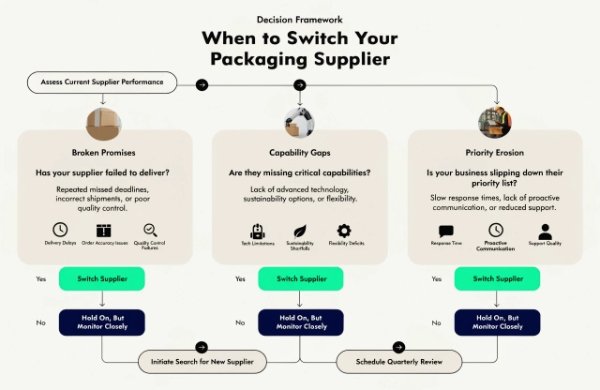 Decision framework for changing suppliers
In the partnerships I've managed, I've seen brands wait too long to make this call. They hope things will improve. They're scared of disruption. They've built personal relationships with the supplier's team. But hope is not a strategy. The brands that protect their growth are the ones who set hard exit criteria in advance and execute when those criteria are met.
Here's how to know when it's time to walk away. First, you've escalated problems repeatedly and nothing changes. You've had the honest conversation. You've given clear feedback. You've waited two quarters. The same problems keep appearing. At that point, the supplier either doesn't have the capability to fix it or doesn't prioritize fixing it. Either way, you're done.
Second, you need capabilities they can't build. You're launching in Europe and need FSC certification. They don't have it and tell you it'll take 18 months to get. You need structural packaging design support. They don't have a design team and won't hire one. You need automated color-matching systems for consistency. They still use visual inspection. These aren't negotiable differences. They're capability gaps that will only widen.
Third, you've become a low-priority account. Your response times have degraded. You're getting pushed to the back of the production queue. When you ask for expedited sampling, you hear "we'll try" instead of "yes." You're bidding for attention against their bigger clients and losing. You won't climb back to priority status unless you 10x your order volume, which isn't realistic.
Here's a decision framework I use:
| Red Flag | Warning Sign | Exit Trigger |
|---|---|---|
| Broken Promises | Supplier commits to improvement | Same problem appears 3+ times after commitment |
| Capability Gap | You need features they don't have | They can't or won't build it within 2 quarters |
| Priority Erosion | Response times or quality degrades | Degradation continues >3 months despite escalation |
| Financial Stress | Late shipments, quality cuts, price spikes | They ask for payment term changes or deposits they didn't require before |
| Communication Breakdown | Can't reach decision-makers | >1 week to get answers on urgent issues |
The hardest part is executing the switch while minimizing disruption. You need to run dual sourcing for at least one production cycle[^11]. That means ordering from your new supplier while maintaining enough inventory from your old supplier to cover any delays. You need to start the transition at least 4 months before you're in[^12]
[^1]: "Enabling manufacturing firms' supply chain performance in ... - PMC", https://pmc.ncbi.nlm.nih.gov/articles/PMC10685374/. Supply chain research indicates that manufacturers optimized for small-batch production frequently encounter operational constraints when scaling to higher volumes, as their infrastructure and processes are designed for different production profiles. Evidence role: general_support; source type: research. Supports: that manufacturing suppliers often face operational challenges when client order volumes increase significantly. Scope note: This supports the general pattern of supplier scalability challenges rather than the specific 1,000 to 10,000 unit threshold mentioned
[^2]: "Strategic Supplier Partnership: A Source of Competitive Advantage", https://www.academia.edu/42301875/Strategic_Supplier_Partnership_A_Source_of_Competitive_Advantage. Supply chain management literature emphasizes that strategic supplier partnerships require continuous relationship management, regular communication, and mutual adaptation, contrasting with transactional procurement approaches. Evidence role: expert_consensus; source type: research. Supports: that strategic supplier relationships require ongoing management and communication rather than transactional approaches.
[^3]: "Examining collaborative buyer–supplier relationships and social ...", https://pmc.ncbi.nlm.nih.gov/articles/PMC9434505/. Research on B2B supplier relationships indicates elevated failure rates in the early stages of partnerships, though specific timeframes vary by industry and relationship type. Evidence role: statistic; source type: research. Supports: that supplier partnerships in manufacturing contexts have high early failure rates. Scope note: General supplier relationship research may not specifically validate the 18-month timeframe for packaging partnerships
[^4]: "What is Supplier Quality Management? Supplier Selection Criteria", https://asq.org/quality-resources/supplier-quality?srsltid=AfmBOopR1EE-wezE92PBxmoRaBNkHyjxL0l5af1FYJ9_h0L2GFvV4up4. Retail supply chain research indicates that major retailers enforce quality compliance standards and commonly reject shipments that fail to meet specifications, with financial consequences for suppliers including lost revenue and potential loss of shelf space. Evidence role: general_support; source type: research. Supports: that retailers maintain quality standards and may reject shipments that fail to meet specifications. Scope note: This supports the general pattern of retailer quality enforcement rather than validating the specific dollar amount or outcome in this case
[^5]: "[PDF] Flexibility Versus Efficiency? A Case Study of Model Changeovers in ...", https://faculty.marshall.usc.edu/Paul-Adler/research/FlexVsEff-2.pdf. Operations management research demonstrates that manufacturing systems involve inherent trade-offs between flexibility and efficiency, with facilities optimized for small-batch production requiring different equipment, layouts, and processes than those designed for high-volume manufacturing. Evidence role: mechanism; source type: education. Supports: that manufacturing facilities face fundamental trade-offs between flexibility and efficiency based on their equipment and process design.
[^6]: "What Is Delta E? And Why Is It Important for Color Accuracy?", https://www.viewsonic.com/library/creative-work/what-is-delta-e-and-why-is-it-important-for-color-accuracy/. Delta E is a metric defined by the International Commission on Illumination (CIE) that quantifies color differences in a perceptually uniform manner, with values below 2 generally considered imperceptible to the human eye and values above 5 representing clearly noticeable differences. Evidence role: definition; source type: education. Supports: that Delta E (ΔE) is a standardized metric for measuring color differences and that values above certain thresholds indicate perceptible color variation.
[^7]: "Absence of personal relationship in a buyer-supplier relationship", https://pmc.ncbi.nlm.nih.gov/articles/PMC6558269/. Research on supplier performance management identifies communication responsiveness and quality consistency as key indicators of relationship health, with degradation in these areas often preceding more serious supply chain disruptions. Evidence role: general_support; source type: research. Supports: that changes in communication patterns and quality performance can indicate deteriorating supplier relationships.
[^8]: "The Short-Term Stress Response – Mother Nature's Mechanism for ...", https://pmc.ncbi.nlm.nih.gov/articles/PMC5964013/. Organizational behavior research indicates that response times and service quality often deteriorate under conditions of high workload or operational stress, as resources become constrained and prioritization mechanisms favor urgent over routine matters. Evidence role: mechanism; source type: research. Supports: that organizational response times tend to degrade under increased operational stress or workload. Scope note: This supports the general pattern of response degradation under stress rather than the specific ratio of 48 hours to 5 days mentioned
[^9]: "Board Leadership, Meetings, and Committees", https://corpgov.law.harvard.edu/2022/08/30/board-leadership-meetings-and-committees/. Research on supplier relationship management indicates that periodic structured reviews facilitate alignment and early problem detection, though optimal frequency varies based on relationship complexity and business context. Evidence role: general_support; source type: research. Supports: that regular structured meetings are important for supplier relationship management. Scope note: This supports the value of regular meetings but does not specifically validate quarterly as the optimal frequency
[^10]: "Forest Stewardship Council - Wikipedia", https://en.wikipedia.org/wiki/Forest_Stewardship_Council. The Forest Stewardship Council (FSC) is an international non-profit organization that provides certification for forest products meeting environmental and social standards, widely recognized in European and global markets as a sustainability credential. Evidence role: definition; source type: institution. Supports: that FSC (Forest Stewardship Council) certification is an internationally recognized standard for responsible forest management.
[^11]: "Business Continuity Management for Supply Chains ...", https://par.nsf.gov/servlets/purl/10229443. Supply chain management literature identifies dual sourcing as a risk mitigation approach that maintains supply continuity during transitions or disruptions, though it involves trade-offs in terms of complexity and cost. Evidence role: general_support; source type: research. Supports: that dual sourcing is a recognized risk mitigation strategy in supply chain management. Scope note: This supports dual sourcing as a general strategy but does not specifically validate the 'one production cycle' timeframe
[^12]: "Transition to a sustainable food supply chain during disruptions", https://pmc.ncbi.nlm.nih.gov/articles/PMC9837209/. Supply chain management research indicates that supplier transitions involve multiple phases including qualification, sampling, process validation, and inventory management, requiring substantial lead time that varies by industry complexity and product specifications. Evidence role: general_support; source type: research. Supports: that supplier transitions require significant lead time for qualification, sampling, and process alignment. Scope note: This supports the need for extended lead times but does not specifically validate the 4-month timeframe, which may vary by context