You just launched your premium skincare line into three markets—EU, Australia, and US. Six weeks later, your Australian shipment sits in customs. Your EU retailer emails asking for recyclability proof you don't have. Your US launch window closes while you scramble to reprint 3,000 boxes. The "cheap" supplier who said they handled compliance just cost you $40,000 and three months.
Non-compliant packaging in 2025 doesn't hit you as a fine—it hits as a cascading supply chain failure that burns cash flow, kills launch momentum, and forces impossible choices between missing retail commitments or selling stock that violates market-specific regulations you didn't know existed.
 Real cost of packaging compliance failures
I manage product compliance at Chocopackage. In the last year, I helped resolve three urgent cases where brands discovered compliance gaps only after shipments were flagged or retailers rejected onboarding paperwork. Every case followed the same pattern: the founder assumed one certification covered all markets, the supplier provided documents on request but no proactive roadmap, and the brand learned the hard way that compliance varies drastically between regions. This isn't about legal technicalities—it's about supply chain decisions that either protect your growth or blow up your launch timeline.
Why do most brands discover compliance failures too late?
You're focused on perfecting the unboxing experience, locking in your launch date, and managing cash flow. Packaging compliance feels like a checkbox—get FSC certification, use recyclable materials, done. That's what your supplier told you. That's what your competitor seems to be doing.
The reality: compliance in 2025 is market-specific, material-specific, and regulation-specific[^1]. FSC proves your paperboard comes from responsible forests[^2]. It doesn't prove your packaging meets EU recyclability mandates, Australian Packaging Covenant targets, or California's plastic ban requirements. Most brands discover these gaps when customs holds their shipment or a retailer asks for documentation they don't have.
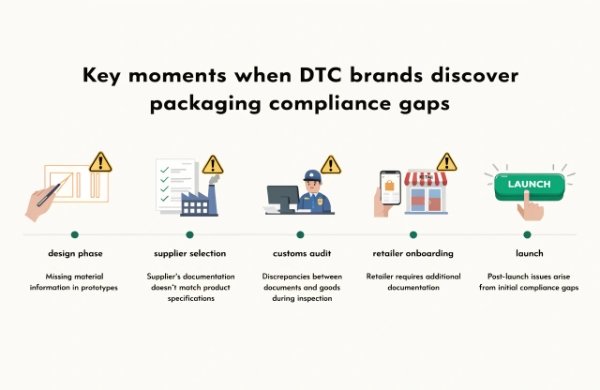 Compliance gap discovery timeline
I worked with a wellness brand launching simultaneously in Germany and Melbourne. They used FSC-certified boxes with a biodegradable window—a material their designer loved for its premium feel. The German retailer flagged the packaging during onboarding because the biodegradable film didn't meet EU Packaging and Packaging Waste Regulation (PPWR) recyclability standards[^3]. The Australian shipment cleared customs but failed the Australian Packaging Covenant (APC) annual reporting threshold for compostability claims[^4]. The brand had two options: accept retailer rejection and customs delays, or reprint both shipments with compliant materials. They chose reprints. Cost: $38,000. Delay: seven weeks. Lost launch window.
The problem wasn't the supplier lying. The supplier provided FSC certificates when asked. But they didn't proactively map the brand's target markets, flag region-specific requirements, or design for multi-market compliance from day one. The brand assumed "eco-friendly biodegradable" equaled "compliant everywhere." It didn't.
What makes 2025 compliance different from previous years?
| Region | 2025 Compliance Focus | Common Assumption | Actual Requirement |
|---|---|---|---|
| EU | PPWR extended producer responsibility (EPR) + recyclability mandates | FSC = compliant | Must prove material enters established recycling streams; biodegradable ≠ recyclable unless certified compostable infrastructure exists |
| Australia | Updated APC targets for recycled content + packaging design for recovery | "Recyclable" logo = done | Must meet minimum recycled content thresholds (30%+ by 2025 for rigid packaging[^5]) + prove packaging design allows separation in MRFs |
| US (state-level) | California AB 1201 (plastic film ban)[^6], Maine EPR, other state laws | Federal FDA = enough | State-specific bans on certain plastics + producer responsibility fees + labeling requirements vary by state |
The shift isn't just new rules—it's fragmentation. A packaging solution that works for New York might violate California law. A material perfect for Germany might fail Australian recyclability tests. Your supplier needs to know this before you place your order, not after your shipment gets flagged.
In another case, a cosmetics brand used post-consumer recycled (PCR) plastic inserts to meet sustainability goals. Their California launch went smoothly. When they expanded to Maine, they discovered Maine's EPR law required brands to register and pay fees based on packaging weight[^7]—a cost they hadn't budgeted. Worse, their insert design didn't meet Maine's definition of "readily recyclable," triggering higher fee tiers. They didn't face customs holds, but their Maine launch cost 22% more than projected because compliance wasn't factored into supplier negotiations.
This is why I always tell clients: compliance isn't a certification you get once. It's a supply chain roadmap you build per market before production starts.
What does a non-compliant packaging failure actually cost?
You read about regulatory fines and think "we'll handle it if it happens." That's not how compliance failures hit scaling brands. The real cost is operational: reprints, customs delays, retailer rejections, and the impossible choice between missing commitments or selling non-compliant stock.
When a shipment gets flagged for non-compliance, you face 4-8 weeks of reprint lead time[^8]—often longer if you need new materials or structural redesigns. That delay kills launch windows, burns cash sitting in inventory you can't sell, and forces you to renegotiate retailer contracts or miss seasonal windows you spent months planning.
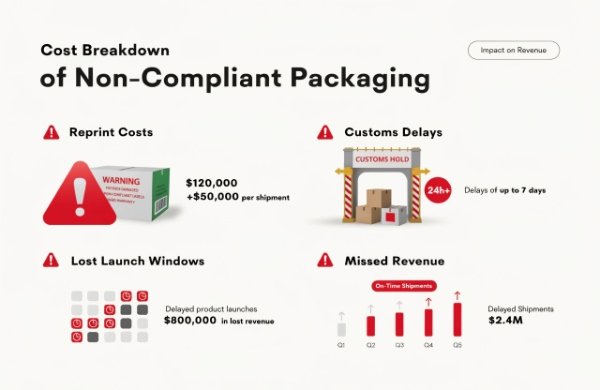
 Operational costs of compliance failure
I helped a hair care brand through this exact scenario. They launched a limited-edition holiday box using a metallic foil finish they loved. The EU retailer requested proof that the packaging met PPWR recyclability standards for coated paperboard. The brand didn't have it. Their supplier said the foil was "recyclable" but couldn't provide third-party verification that EU recycling facilities actually processed that specific coating[^9]. The retailer refused to stock the product without documentation.
The brand had three options:
- Reprint with verified materials: 6-week lead time + $32,000 reprint cost + miss the holiday window entirely
- Ship non-compliant stock anyway: Risk retailer penalties, potential customs seizure, and brand reputation damage
- Cancel the EU launch: Lose retailer relationship and pre-committed marketing spend
They chose option one. The reprint worked, but they missed Black Friday and Cyber Monday. The holiday product launched in mid-January with minimal sales. Total financial impact: $75,000+ when accounting for reprint costs, lost seasonal revenue, and wasted marketing spend.
The most painful part? The compliance issue was preventable. If the supplier had proactively flagged EU recyclability requirements during the design phase, the brand could have chosen a verified coating from day one. No delay. No reprint. No missed window.
How do brands typically misunderstand compliance?
| Common Belief | Reality in 2025 | Consequence |
|---|---|---|
| "FSC certification means we're compliant" | FSC proves forest sourcing only—doesn't address recyclability, PCR content, or regional EPR requirements | Customs delays when regulators ask for region-specific docs |
| "Our material is biodegradable, so it's eco-compliant" | Biodegradable ≠ compliant unless certified compostable facilities exist in target market[^10] + meets recyclability mandates | EU PPWR violations, retailer rejections |
| "Recyclable logo = we're covered" | Logos require proof that material actually enters recycling streams in each market—not just theoretical recyclability | Greenwashing accusations, retailer onboarding failures |
| "We handle compliance at the end, before shipping" | Compliance gaps often require material or structural redesigns that add 4-8 weeks—impossible to fix last-minute | Emergency reprints, missed launch windows, cash flow crises |
This table shows why compliance can't be a last-minute checklist. It's a supply chain foundation that either supports your growth or becomes your biggest bottleneck.
What questions should you ask your supplier before production starts?
You shouldn't need to become a compliance expert. That's why you work with a supplier. But you do need to ask the right questions to know if your supplier actually understands multi-market compliance or just provides certificates on request.
The difference between a compliance-aware supplier and a reactive one shows up in how they answer three core questions: Do they map your target markets before quoting? Do they proactively flag region-specific risks? Do they connect you with third-party verifiers, or do they expect you to figure it out alone?
 Supplier compliance readiness checklist
Here's what I ask every time a client approaches us with a new project:
Pre-Production Compliance Checklist
-
Market Mapping: Which regions are you launching in? What are the specific compliance requirements for each market? (Not generic—actual regulatory frameworks like EU PPWR Article 6, Australian APC 2025 Targets, California AB 1201.)
-
Material Verification: For each material you're proposing (paperboard, coatings, inserts, adhesives), do you have third-party verification that it meets recyclability or compostability standards in my target markets? Can you provide documentation before production?
-
Certifications Provided: Which certifications do you hold (FSC, GRS, BPI, others)? Which ones apply to this specific project? If I need additional certifications (like GRS for recycled content or BPI for compostability), do you have existing relationships with third-party verifiers, or do I need to source them myself?
-
Design for Compliance: If my current design violates a regulation in one of my target markets, will you flag it during the prototyping phase, or will I discover it after production? What's your process for proactive compliance reviews?
-
Regulatory Changes: How do you stay updated on changing regulations (like new EPR laws or plastic bans)? Will you notify me if a regulation changes between our initial order and future reorders?
-
Documentation Support: What documentation do you provide for customs, retailer onboarding, and regulatory audits? Do you package these docs with shipments, or do I need to request them separately?
I had a client who asked their previous supplier these questions. The supplier responded: "We're FSC-certified. That covers everything." That answer should be a red flag. FSC is critical, but it doesn't address recyclability mandates, EPR registration, or material-specific regulations. A compliance-aware supplier would say: "We're FSC-certified for forest sourcing. For EU recyclability, we use materials verified by [specific third-party]. For Australian APC targets, we can design with 30%+ PCR content. Here's our documentation process."
That difference matters. It's the difference between a supplier who prevents problems and one who reacts after your shipment gets flagged.
How do we help clients avoid these compliance traps?
I'm not a lawyer. I don't provide regulatory consulting. My job is supply chain orchestration—connecting brands with the right materials, certifications, and third-party verifiers so compliance doesn't become a bottleneck.
When a client tells me their target markets, I map region-specific requirements before quoting. If their design uses a material that won't meet EU recyclability standards or Australian PCR targets, I flag it during prototyping—not after production. I connect them with verifiers who can certify compostability, recyclability, or other claims. I structure documentation so customs and retailer onboarding go smoothly.
 Chocopackage compliance orchestration process
In one recent case, a supplement brand wanted a window box to showcase their product. They loved the idea of a biodegradable PLA window. I asked: "Are you launching in the EU?" They said yes. I explained that PLA biodegradability doesn't meet EU PPWR recyclability mandates unless the material enters certified industrial composting streams[^11]—which most EU municipalities don't have. Instead, I suggested a recyclable PET window with recycled content, verified by a third-party that EU retailers recognize. The brand made the switch during prototyping. No delays. No reprints. No retailer rejections.
That's what compliance orchestration looks like. It's not about saying "no" to creative ideas—it's about steering those ideas toward materials and structures that actually work in your target markets.
What does proactive compliance roadmapping prevent?
- Customs Holds: Documentation is included with shipments, pre-verified to meet regional import requirements
- Retailer Rejections: Materials and certifications match retailer onboarding checklists before you sign contracts
- Emergency Reprints: Design reviews during prototyping catch compliance gaps when fixes are cheap and fast
- Greenwashing Accusations: Claims like "recyclable" or "compostable" are backed by third-party verification specific to target markets
- Regulatory Fines: While rare for first-time offenders, proactive compliance eliminates the operational chaos that often precedes fines
I've never seen a brand get fined as their first consequence. What I see constantly is customs delays, retailer pushback, and emergency reprints—all of which cost more than fines ever would.
Conclusion
Non-compliant packaging in 2025 doesn't announce itself with fines—it reveals itself through customs holds, retailer rejections, and reprint costs that kill your launch momentum when it's already too late to fix cheaply. The question isn't whether to prioritize compliance—it's whether your supplier maps multi-market requirements before production or forces you to discover gaps after your shipment ships.
[^1]: "Impact of emerging packaging regulations on international trade and ...", https://www.canr.msu.edu/news/impact-of-emerging-packaging-regulations-on-international-trade-and-product-safety-with-emphasis-on-plastic-reuse-and-recycling-in-europe-and-north-america. Research on international packaging regulations documents significant variation in compliance requirements across jurisdictions, with different standards for material composition, recyclability definitions, and producer responsibility obligations creating complex multi-market compliance landscapes. Evidence role: expert_consensus; source type: research. Supports: the fragmented nature of international packaging regulations.
[^2]: "Forest Stewardship Council - Wikipedia", https://en.wikipedia.org/wiki/Forest_Stewardship_Council. The Forest Stewardship Council (FSC) certification system verifies that forest products originate from responsibly managed forests meeting environmental, social, and economic standards, providing chain-of-custody documentation for certified materials. Evidence role: definition; source type: institution. Supports: the scope and purpose of FSC certification.
[^3]: "Packaging Waste Regulation - EU Environment - European Union", https://environment.ec.europa.eu/topics/waste-and-recycling/packaging-waste/packaging-packaging-waste-regulation_en. The EU Packaging and Packaging Waste Regulation establishes recyclability requirements for packaging materials placed on the European market, including specific criteria for material recovery in established waste streams. Evidence role: definition; source type: government. Supports: the existence and scope of EU PPWR recyclability standards. Scope note: The source confirms the regulation's framework but may not detail specific biodegradable film exclusions mentioned in the article's case study.
[^4]: "APCO Explainer: Sustainable Packaging in Australia - Specright", https://www.specright.com/blog/australian-packaging-covenant-organisation/. The Australian Packaging Covenant Organization administers reporting obligations for signatories regarding packaging sustainability claims and targets, including documentation requirements for environmental assertions. Evidence role: definition; source type: government. Supports: the existence of APC reporting requirements for packaging claims. Scope note: The source may describe general reporting frameworks rather than specific thresholds for compostability claims as described in the article.
[^5]: "Australian Packaging Covenant Organisation - DCCEEW", https://www.dcceew.gov.au/environment/protection/waste/packaging/packaging-covenant. The Australian Packaging Covenant Organization established 2025 National Packaging Targets including recycled content thresholds for various packaging categories as part of the National Waste Policy Action Plan. Evidence role: statistic; source type: government. Supports: Australia's 2025 recycled content targets for packaging. Scope note: The source confirms national targets exist but may specify different percentages or categories than the 30% rigid packaging figure cited in the article.
[^6]: "Truth-in-Labeling Laws: Protecting California Consumers from ...", https://calrecycle.ca.gov/plastics/labeling/. California Assembly Bill 1201 addresses plastic packaging materials and establishes restrictions on certain film types as part of the state's extended producer responsibility framework. Evidence role: definition; source type: government. Supports: the existence and scope of California AB 1201. Scope note: The source confirms the bill's existence but may not detail the specific plastic film categories banned as implied in the article.
[^7]: "Stewardship Program for Packaging - Waste Management - Maine.gov", https://www.maine.gov/dep/waste/recycle/epr.html. Maine's Extended Producer Responsibility for Packaging law establishes a stewardship program requiring producers to register and contribute to packaging management costs, with fee structures based on material characteristics. Evidence role: mechanism; source type: government. Supports: Maine's EPR law structure for packaging producer responsibility. Scope note: The source confirms Maine's EPR framework but may not specify that fees are calculated exclusively by weight as the article suggests.
[^8]: "Packaging Lead Time - Time May Not Be On Your Side", https://www.howtobuypackaging.com/packaging-lead-time/. Custom packaging production lead times vary by complexity, material availability, and order volume, with industry sources indicating timelines ranging from several weeks to months for new production runs requiring material changes or structural modifications. Evidence role: general_support; source type: other. Supports: typical lead times for custom packaging production. Scope note: The source provides general industry context but may not confirm the specific 4-8 week range for compliance-driven reprints cited in the article.
[^9]: "Recycling of post-consumer plastic packaging waste in the EU", https://pmc.ncbi.nlm.nih.gov/articles/PMC8162419/. Studies of European recycling infrastructure document that material recovery facilities have varying technical capabilities to process different packaging materials and coatings, with acceptance and processing rates depending on local infrastructure, contamination levels, and material composition. Evidence role: mechanism; source type: research. Supports: variation in recycling facility capabilities across materials. Scope note: The source confirms general infrastructure variation but may not address the specific metallic foil coating scenario described in the article.
[^10]: "Biodegradable and compostable alternatives to conventional plastics", https://pmc.ncbi.nlm.nih.gov/articles/PMC2873018/. Research on packaging waste management distinguishes between biodegradable materials (which break down under certain conditions) and regulatory compliance, which typically requires certified compostability standards and access to appropriate industrial composting infrastructure for proper end-of-life processing. Evidence role: definition; source type: research. Supports: the distinction between biodegradability and regulatory compliance for packaging.
[^11]: "The Life Cycle Assessment for Polylactic Acid (PLA) to Make It a Low ...", https://pmc.ncbi.nlm.nih.gov/articles/PMC8199738/. Research on polylactic acid (PLA) packaging indicates that while PLA is biodegradable under industrial composting conditions, its end-of-life processing requires specific infrastructure that is not universally available, and PLA contamination can complicate conventional plastic recycling streams. Evidence role: mechanism; source type: research. Supports: PLA end-of-life processing requirements and infrastructure limitations. Scope note: The source confirms PLA processing requirements but may not directly address EU PPWR recyclability mandate compliance as specifically framed in the article.