You open a new shipment of your premium skincare boxes. One batch looks perfect. The next one feels off. Customers notice. Returns climb. Your brand trust drops fast. I see this pain every week as Product Manager at Choco Package.
Yes, you can achieve ΔE < 1 color consistency[^1] across every batch, even with low MOQ starting at 500 pieces. We use in-house spectrophotometers[^2], digital color standards[^3], and controlled D65 lighting booths[^4] to lock in imperceptible color matches. This keeps your unboxing experience flawless and protects your premium positioning without forcing large inventory commitments.
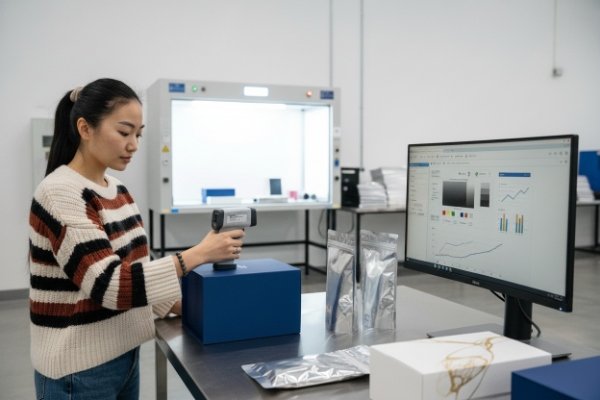
ΔE < 1 Color Matching Process
I know how frustrating color shifts[^5] can be. They quietly hurt sales and damage the strong brand story you worked hard to build. Keep reading. I will show you exactly why this happens and how to fix it for good in 2026.
Why Color Inconsistency Is quietly Killing DTC Brands’ Reputation and Profits
Your customers expect every product to look exactly like the images on your site. When colors vary, they feel disappointed. They post photos on social media. Returns increase. Negative reviews follow.
Color inconsistency above ΔE 2–3 leads to visible differences that customers notice immediately. This causes higher return rates[^6], lost repeat purchases, and damage to your premium image. Brands lose thousands in refunds and marketing fixes every year because of mismatched batches.

Impact of Color Inconsistency on DTC Brands
I remember one founder who came to us after a bad batch. Her luxury gift boxes[^7] looked different from the approved sample. Social media comments poured in. Sales slowed for weeks. She told me the shift cost her more than just money. It hurt the emotional connection she built with her community.
The Real Cost of Visible Color Shifts
Color problems hit your business in several ways. Here is a clear breakdown:
| Issue | Direct Impact | Hidden Cost |
|---|---|---|
| Customer complaints | More support tickets | Team time lost answering questions |
| Return rates | 10-20% increase | Shipping fees and restocking |
| Brand perception | Weakens premium feel | Lower lifetime customer value |
| Social media backlash | Negative posts spread fast | Extra marketing spend to recover |
These numbers add up quickly for scaling DTC brands in skincare, cosmetics, or wellness.
How Inconsistency Affects Different Teams
Founders worry about the “wow” unboxing moment. Operations leads hate unpredictable quality. Compliance teams fear it signals poor control. Everyone feels the pressure when batches do not match.
At Choco Package, we see these stories often. We help brands move past this pain. Our rigid boxes and folding cartons maintain perfect color because we treat consistency as science. Check our cosmetics personal care packaging solutions if you work in beauty.
Color inconsistency does more than annoy. It breaks the trust you built through careful storytelling. Customers buy your brand for the experience. When the box color shifts[^5], they question everything else. Many brands lose 15-25% of potential repeat sales because of this single issue.
Think about your own shopping habits. You notice when a favorite product looks different. You hesitate next time. For premium DTC brands, this hesitation turns into lost revenue. Operations teams spend hours inspecting returns instead of improving processes. Sustainability officers worry that inconsistent quality makes eco claims less believable.
We use data from real projects. One client reduced returns by 40% after we locked their color standard. They launched faster because they no longer waited for perfect matches on large runs. Low MOQ gave them freedom to test new colors without risk.
Another angle: social media amplifies small problems. A single mismatched unboxing video can reach thousands. Comments focus on the color instead of your product benefits. This shifts attention away from your innovation and toward supplier issues you cannot control alone.
Critically, many founders accept small variations as normal. They think “close enough” works for low volumes. But in 2026, customers expect perfection. Competitors who solve this gain loyalty. They keep their visual identity strong across every SKU and every format.
We also see batch variation hurt wholesale relationships. Retail buyers spot differences on the shelf. They question your quality control. This can delay or cancel orders. For nutraceuticals or food brands, color consistency even affects perceived freshness and safety signals.
I share these details because I want you to avoid the same traps. At Choco Package, we act as your Brand Guardian. We deliver ΔE < 1 so your packaging reinforces premium positioning every single time. Explore our luxury gift packaging options if you need that extra wow factor.
The Hidden Reasons Most Suppliers Fail to Deliver ΔE < 1 at Low MOQ
Suppliers promise perfect color. Then small orders arrive with shifts. You wonder what went wrong. Most factories struggle when quantities stay low.
Most suppliers fail at ΔE < 1 with low MOQ because they lack proper tools and systems. They rely on old physical swatches instead of digital standards. They skip full spectrophotometer checks. Lighting conditions vary. This creates visible differences that hurt your brand.

Common Supplier Color Control Failures
I talked with many operations leads who switched to us after repeated failures. One told me their previous factory mixed ink by eye for small runs. The result was always a gamble.
Root Causes of Color Deviation at Low Volumes
Several factors combine to break consistency:
- Different material batches arrive with natural variations
- Ink mixing lacks precision without calibrated equipment
- Printing pressure and temperature change between short runs
- No standardized way to communicate color between designer and factory
- Absence of archived digital records for future reference
These issues become worse at low MOQ. Factories rush setup for small jobs. They cut corners on quality gates.
Why Traditional Approaches Break Down
Many suppliers still use outdated methods. They compare colors under regular office lights instead of D65 standard booths. They measure only once at the end instead of at multiple stages. For sustainable materials like FSC or PCR, variation increases because base substrates differ more.
Here is a simple comparison table:
| Factor | Traditional Supplier | Reliable Partner |
|---|---|---|
| Color tool | Physical swatches | Digital Pantone + spectrophotometer |
| Measurement | Visual check only | Multiple instrument readings |
| Lighting | Ambient room light | Controlled D65 booth |
| Records | Paper notes | Archived digital CMS |
| Low MOQ support | Often refused or inconsistent | Standard process from 500 pcs |
This table shows why results differ so much.
Product development managers feel this pain deeply. They design beautiful concepts with spot UV[^8], embossing, or hot foil. Then production fails to match the approved shade. Delays pile up. Creativity suffers.
Sustainability officers face extra challenges. They need FSC certified materials[^9] that still deliver luxury feel. Many suppliers cannot guarantee color when switching to recycled content. This creates compliance risks in 2026 with stricter EU EPR and Australian rules.
I experienced this myself early in my career. We once approved a sample under perfect conditions. Production used a slightly different paper stock. The final boxes looked dull under store lighting. The client called us in panic. That moment taught me why controlled processes matter at every step.
At Choco Package, we solve these hidden reasons head-on. We maintain in-house calibration and strict CMS tracking. Visit our about page to learn how we became the strategic partner for scaling brands.
Let us break this down further with critical thinking. Low MOQ makes color control harder because setup costs spread over fewer units. Factories hesitate to invest time in full calibration for small jobs. They reuse old ink mixes without fresh testing. Temperature fluctuations in the press affect dot gain differently on short runs.
Material variation adds another layer. Paper from one lot absorbs ink differently than the next. Without spectrophotometer data at incoming inspection, problems show up too late. For CBD or supplement packaging, this inconsistency can even raise regulatory questions about accurate branding.
Printing pressure changes with machine warm-up. Short runs never reach steady state like long runs do. Ink viscosity shifts. Without real-time monitoring, each batch drifts.
Communication gaps make everything worse. Designers send RGB files. Factories convert to CMYK without proper proofing. Spot colors get approximated. No one tracks the exact Lab values.
Critically, many suppliers claim they can do low MOQ but skip the expensive tools. They hope visual approval passes. Customers with trained eyes notice the difference. Returns follow. Brand managers then blame the entire supply chain.
We took a different path. We invested in elite color-matching technology so ΔE < 1 becomes our daily standard. This helps [e-commerce retail shipping](https://www.pitneybowes.com/us/blog/ecommerce-shipping-process-guide.html)[^10] boxes look premium even in high-volume fulfillment.
Our clients in nutraceuticals tell us this reliability lets them focus on formulation instead of chasing suppliers. One sustainability officer praised our verified FSC materials that still hold perfect color. No more trade-offs.
The key insight: color consistency at low MOQ requires systems, not luck. Most suppliers treat it as an art. We treat it as repeatable science. This difference saves brands time, money, and reputation.
How to Guarantee ΔE < 1 Color Consistency Batch After Batch – A Practical 2026 Framework
You want a clear process you can follow. You need steps that actually work in real production.
Follow this 2026 framework to guarantee ΔE < 1: Start with digital color standards[^3], measure with spectrophotometers at every stage, use D65 lighting for approval, and archive records for every batch. This system removes guesswork and delivers repeatable results even at low MOQ.
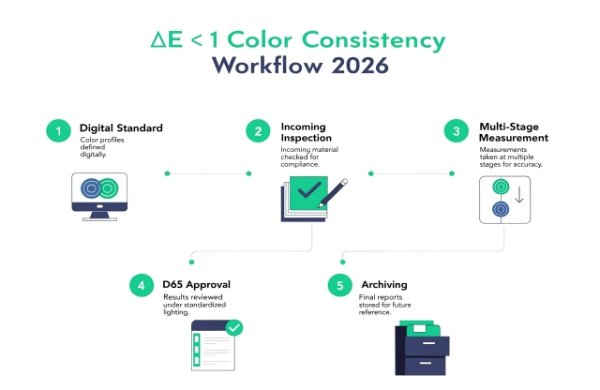
Practical Framework for ΔE < 1 Consistency
I built parts of this framework from years of fixing supplier mistakes. It works for rigid boxes, stand-up pouches, and custom labels[^11] alike.
Step 1: Set Digital Standards Early
Send Pantone or Lab values instead of printed swatches. We convert them precisely.
Step 2: Incoming Material Inspection
Measure base substrates before printing. Reject variations early.
Step 3: Multi-Stage Measurement
Check color after proofing, during press runs, and at final inspection. Use calibrated devices.
Step 4: Controlled Viewing Environment
Approve under D65 daylight simulation. This matches how customers see your packaging.
Step 5: Digital Archiving
Save every measurement in your CMS. Reference it for future orders.
Here is a quick checklist table you can use today:
- Define target Lab values with client
- Calibrate all equipment weekly
- Measure at 5+ points per sheet
- Compare against archived standard
- Document lighting conditions
This framework scales from 500 pieces to thousands.
Product development teams love it because they get fast feedback during prototyping. We offer 7-day rapid samples so you test without delay.
Operations leads appreciate the predictability. No more surprise shifts that delay launches.
Advanced Tips for Complex Finishes
When you add spot UV[^8], embossing, or foil, color perception changes. We adjust base inks to compensate. Measurement still targets ΔE < 1 under the final surface.
For sustainable options, we test PCR and FSC stocks separately. We adjust processes so luxury feel stays intact.
I once helped a wellness brand launch new supplement jars. We followed this exact framework. Every batch matched perfectly across six SKUs. Their unboxing videos looked identical. Sales grew steadily.
Check our stand-up pouches or paper tubes if your products need flexible formats.
Dive deeper into the framework with critical analysis. Many brands stop at visual approval. That leaves room for metamerism[^12] — colors that match under one light but shift under another. Our D65 booths catch this early.
Short runs challenge steady-state printing. We use smaller presses tuned for low volume and monitor temperature in real time. This prevents drift that larger factories ignore.
Data tracking matters. Without archived records, each new order starts from zero. We keep digital histories so repeat orders match exactly, even months later.
Critically, communication closes the loop. We review designs with you before production. We flag potential issues like gradient-heavy art that risks banding. This collaborative step saves revisions.
For compliance-focused teams, we provide full documentation. This supports your ESG reports and avoids greenwashing risks. Our verified certifications cover FSC, GRS, and more.
One innovator client added hot foil to their custom labels[^11]. We adjusted the undercolor so the foil pop stayed consistent. ΔE stayed below 1 across the metallic and printed areas. The result felt truly premium.
This framework is not theory. We apply it daily for cosmetics, food, and CBD packaging. It gives you confidence to iterate designs quickly without color fears holding you back.
Explore more practical tips on our blog. Or see full capabilities on the homepage.
How Choco Package Delivers True ΔE < 1 Consistency Even from 500 pcs
You need a partner who actually delivers on the promise for small orders.
At Choco Package, we deliver true ΔE < 1 consistency from 500 pieces because we combine elite in-house technology, strict processes, and years of experience as your Brand Guardian. Our spectrophotometers, digital CMS, and D65 booths make color science reliable at low MOQ.
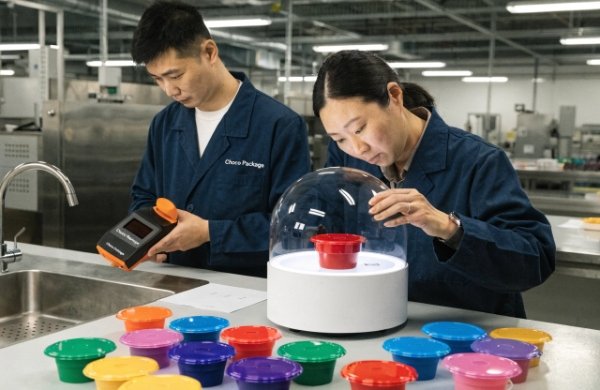
Choco Package Color Consistency Advantage
As Product Manager, I oversee every color project. I make sure we never treat low MOQ as an afterthought.
Our Core Technical Advantages
- In-house spectrophotometers calibrated daily
- Full color management system with archived standards
- Dedicated D65 lighting inspection rooms
- Multi-stage quality gates during production
- Experienced technicians trained on luxury finishes
We support custom labels and tags with the same precision.
Real Results Our Clients See
Founders launch faster without inventory traps. Operations teams get predictable timelines. Sustainability officers receive compliant materials that look premium. Innovators get yes to complex structural designs.
I personally reviewed a project for a skincare brand last month. They needed rose gold foil on rigid boxes at 800 pieces. Our measurements stayed at ΔE 0.8 across the entire run. The unboxing moment matched their vision perfectly.
We also handle sustainable shipping mailers with the same color control.
What sets us apart is integration. We do not outsource color critical steps. Everything happens under one roof with unified standards. This eliminates the hand-off errors common elsewhere.
Our low MOQ policy comes from real investment. We designed processes that stay efficient at small scale. Setup time is minimized through digital tools. Waste is reduced because we get it right the first time.
Critically, we treat every order with the same rigor. Whether 500 or 5000 pieces, the CMS tracks data identically. This creates the reliability scaling brands need.
For compliance officers, we supply full traceability reports. This supports audits and builds trust with retailers.
Product developers appreciate our 7-day prototyping. They test finishes like debossing or spot UV and see accurate color proofs quickly.
One operations lead shared that our consistency cut their quality inspection time in half. They now trust incoming shipments without extra checks.
We bridge the gap between premium aspiration and operational efficiency. Our four strengths — Risk Mitigator, Brand Guardian, Compliance Architect, and End-to-End Orchestrator — all support perfect color delivery.
Contact us to experience the difference. Visit contact page for your free audit.
Ready to Launch with Perfect Color Consistency? Get Your Free Color Audit & Quote in 24 Hours
Your next launch deserves flawless color from day one. Do not let inconsistency slow you down.
Yes, you can start today. Contact Choco Package for a free color audit and quote within 24 hours. We review your files, measure against standards, and show exactly how we will deliver ΔE < 1 for your project — even at low MOQ.
Get Your Free Color Audit Today
I look forward to helping your brand shine consistently.
Take the first step. Book your audit now and protect your premium unboxing experience.
Conclusion
Color consistency (ΔE < 1) is table stakes for premium DTC brands in 2026. Choose the right partner and processes to protect your reputation and grow with confidence. At Choco Package, we make it our standard.
FAQ
What does ΔE < 1 actually mean for my packaging?
ΔE < 1 means the color difference is imperceptible to most human eyes. Your boxes look identical across batches. Customers see the exact premium shade you intended. This builds trust and reduces complaints.
Is it really possible to achieve ΔE < 1 at low MOQ (500–1000 pcs)?
Yes. With proper digital tools, spectrophotometer measurements, and controlled processes, we deliver it reliably from 500 pieces. Traditional factories struggle, but our systems make it standard.
Why do most suppliers fail at color consistency when order quantity is small?
They lack in-house measurement equipment, skip multi-stage checks, and use inconsistent lighting. Low volumes make them cut corners on calibration and archiving. This leads to visible shifts.
How does Choco Package guarantee ΔE < 1 across every batch?
We use daily-calibrated spectrophotometers, digital CMS archiving, D65 lighting booths, and checks at every production stage. Our Brand Guardian approach ensures consistency from 500 pcs onward.
How long does it take to get color-matched samples?
We deliver rapid prototypes in 7 days. You review accurate color under proper conditions before full production starts. This speeds up your launch timeline significantly.
Can I get ΔE < 1 consistency with sustainable / FSC / PCR materials?
Yes. We test and adjust for recycled and certified stocks. Our processes maintain luxury appearance and color precision while meeting 2026 compliance standards like FSC and GRS.
Explore more on our blog or see packaging for your category at food beverage and cbd packaging.
[^1]: Understanding ΔE < 1 can help you ensure your products maintain color accuracy, enhancing customer satisfaction.
[^2]: Learn how in-house spectrophotometers can enhance your color matching process and reduce returns.
[^3]: Explore the significance of digital color standards in achieving consistent product quality.
[^4]: Discover how D65 lighting booths can help ensure accurate color perception in packaging.
[^5]: Understanding the causes of color shifts can help you prevent them and maintain brand integrity.
[^6]: Explore the key factors that can affect return rates and how to mitigate them.
[^7]: Explore the elements that make luxury gift boxes desirable and how to enhance their appeal.
[^8]: Explore how spot UV can enhance packaging aesthetics and its impact on color perception.
[^9]: Learn about the importance of FSC certification in sustainable packaging practices.
[^10]: Discover best practices for maintaining quality in e-commerce shipping to enhance customer satisfaction.
[^11]: Explore tips for designing custom labels that enhance product appeal and brand identity.
[^12]: Understanding metamerism can help you avoid color matching issues in different lighting.