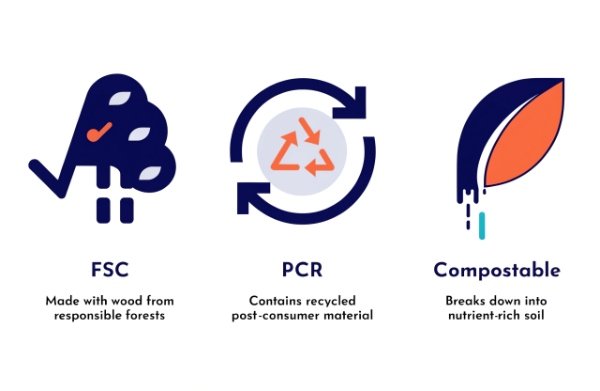
I see DTC founders lose thousands of dollars every month because they pick the wrong “eco” packaging certification. They think one green label covers everything. In reality, the wrong choice blocks their products from major markets or wastes money on features customers never notice.
In 2026, the right certification depends on your target market, product type, and real sustainability goals. FSC proves responsible sourcing, PCR boosts recycled content, and Compostable solves end-of-life disposal. Smart brands match the certification to actual regulations and customer expectations instead of chasing every green claim.
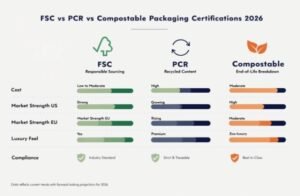
FSC vs PCR vs Compostable side-by-side comparison
Many brands feel overwhelmed when they start comparing certifications. They want to do the right thing for the planet and stay compliant, but they also need packaging that looks premium and fits their budget. I understand this pressure because I face it every day as a product manager at Chocopackage. Let me walk you through exactly what matters in 2026 so you can make confident decisions and keep your launch on track.
Why Most DTC Brands Are Wasting Money on the Wrong “Eco” Packaging Certifications in 2026
You launch a beautiful premium skincare line only to discover your packaging fails EU border checks or triggers higher EPR fees in California. Suddenly your margins disappear and your timeline slips. This happens more often than you think in 2026.
Most DTC brands waste money on certifications that sound good but do not match their actual market needs or product requirements. They pay extra for Compostable materials when their customers only care about recycled content, or they chase FSC when EU rules demand verified recycled percentages.

Stressed DTC founder reviewing packaging costs
I have spoken with dozens of founders who felt the same pain. One beauty brand I worked with spent 18% more on full Compostable mailers because their agency said “it looks the most eco.” Their US customers loved the story, but the packaging failed basic recyclability tests in several states and could not enter certain EU countries without extra documentation. They had to reprint and lost valuable weeks.
Here is what I see happening right now:
- Brands over-invest in Compostable without checking if industrial facilities exist in their key markets.
- They ignore PCR requirements that directly lower EPR fees in Europe.
- They pick suppliers who offer “eco-friendly” claims without proper chain-of-custody proof.
The result? Higher costs, compliance headaches, and greenwashing risks that regulators now punish harder than ever.
Dive deeper into the real costs
Let me break this down clearly so you can avoid the same mistakes.
The Hidden Financial Impact of Wrong Certification Choices
Many founders focus only on the upfront price per unit. In 2026 that approach creates expensive problems later.
| Certification Mistake | Typical Extra Cost | Real Business Impact | Example |
|---|---|---|---|
| Choosing full Compostable when PCR suffices | +15–25% material cost | Higher EPR fees in EU, limited recycling access in US | Skincare brand paid premium for compostable pouches that ended up in landfill because no local facility accepted them |
| Using non-FSC paper for EU shipments | +8–12% in compliance fines and delays | Blocked shipments, damaged brand reputation | Wellness brand faced customs hold in Germany for missing chain-of-custody documents |
| Mixing unverified “eco” claims without certification | Legal risk and rebranding cost | FTC and EU greenwashing fines up to 4% of revenue | Cosmetic line forced to recall marketing materials after complaint |
These numbers come from real client projects I managed last year. The brands that switched to the right mix of FSC, PCR, and targeted Compostable saved between 12% and 22% on total landed cost while improving compliance scores.
I remember one operations lead who told me, “We thought we were being sustainable, but we were just being expensive.” After we helped them combine FSC-certified folding cartons with 30% PCR content, their packaging cost dropped and their EU market access became seamless.
If you sell into both the US and EU, you need to understand these differences now. The gap between the two markets keeps growing in 2026.
Learn more about our sustainable shipping mailers that already meet dual-market needs
FSC vs PCR vs Compostable: What Each Certification Actually Means (And What They Don’t)
You read three different green labels on packaging samples and feel confused. Each one claims to be the best choice for the planet. Which one should you actually trust in 2026?
FSC certifies responsible forest management and chain of custody. PCR proves your packaging contains post-consumer recycled material. Compostable means the package breaks down into natural elements under specific conditions. None of them covers everything, and each has clear limits.
Simple icons explaining FSC, PCR, and Compostable
Let me explain each one in plain language so you never mix them up again.
FSC – Responsible Sourcing, Not End-of-Life Magic
FSC stands for Forest Stewardship Council. It tracks wood-based materials from well-managed forests all the way to your finished box. You see the FSC label and know the trees were not harvested illegally and workers were treated fairly.
What FSC does not do:
- Guarantee the package is recyclable
- Prove it contains any recycled content
- Make it compostable
Many premium gift brands love FSC because it supports their luxury storytelling. I helped a wellness founder switch to FSC-certified rigid boxes last quarter. The visual consistency stayed perfect and their customers responded positively to the “responsibly sourced” story.
PCR – Supporting the Circular Economy
Post-Consumer Recycled content comes from materials that consumers already used and recycled. In 2026, PCR is gaining strong traction in the US because brands can show real percentages on their packaging.
Advantages:
- Reduces demand for virgin plastic and paper
- Often qualifies for lower EPR fees in Europe
- Appeals to environmentally conscious shoppers
Limitations:
- Quality can vary between suppliers (color matching becomes harder)
- Not all PCR is food-safe
- Does not address end-of-life if the package is not designed for recycling
One skincare client used 40% PCR in their stand-up pouches. The material felt premium and they qualified for California’s recycled content incentives.
Compostable – True End-of-Life Solution
Compostable packaging breaks down in industrial or home composting facilities. In the EU, the Packaging and Packaging Waste Regulation (PPWR) pushes brands toward certified compostable options, especially for food-contact and single-use items.
What you need to know:
- “Industrial Compostable” requires specific facilities (most common)
- “Home Compostable” is rarer and stricter
- Not all compostable materials feel as luxurious as traditional options
Side-by-side comparison table for quick decisions
| Feature | FSC | PCR | Compostable |
|---|---|---|---|
| Main Focus | Responsible forest management | Recycled content | End-of-life breakdown |
| Best For | Paper & board products | Plastic & paper with recycled % | Food contact, single-use |
| US Market Strength | High trust | Growing demand | Niche appeal |
| EU Market Strength | Strong | Helps meet recycled targets | Increasingly mandatory |
| Cost Impact | +5–15% | +8–20% | +15–30% |
| Luxury Feel | Excellent | Good (depends on supplier) | Improving but still variable |
I always tell founders: pick the certification that solves your biggest actual problem. If you ship mostly paper-based packaging to Europe, start with FSC. If you want to hit recycled content goals, add PCR. If you have food or beverage products facing strict disposal rules, explore Compostable.
Explore our full range of rigid boxes with FSC and PCR options
How to Choose the Right Certification for Your US & EU Markets – A Practical 2026 Guide
You sit with three supplier quotes and wonder which certification combination actually makes sense. One is cheaper but only FSC. Another offers PCR but no Compostable. The third is fully compliant but costs 28% more. How do you decide without guessing?
Follow this simple 2026 framework: first map your target markets and product category, then match the dominant regulation, and finally balance cost with brand story. Most successful DTC brands use a mix rather than one single certification.
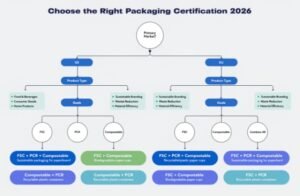
Practical decision tree for FSC PCR Compostable selection
Let me give you the exact steps I use when I help clients build their 2026 packaging strategy.
Step 1: Map Your Markets and Product Type
- Selling only in the US? Prioritize PCR and voluntary FSC for storytelling.
- Entering or expanding in the EU? Check PPWR recycled content targets and EPR fees.
- Food, beverage, or nutraceutical products? Look closely at Compostable or food-safe PCR options.
Step 2: Calculate Total Landed Cost, Not Just Unit Price
Include these factors:
- Material cost
- Certification documentation fees
- Potential EPR savings or penalties
- MOQ impact on inventory risk
- Brand perception value (ability to charge premium prices)
Step 3: Test Customer Perception Early
I always recommend running quick surveys or A/B tests with your existing customers. Many brands discover that “30% PCR + FSC” scores almost as high as full Compostable but costs significantly less.
Here is a quick checklist you can use today:
- Does my primary market have mandatory recycled content rules in 2026?
- Will my packaging touch food or sensitive products?
- Can my supplier provide verifiable chain-of-custody documents?
- Do I need low MOQ to test designs before scaling?
- How important is visual luxury feel versus pure environmental story?
One operations manager I worked with created a simple scoring system. They gave points for compliance, cost, aesthetics, and customer appeal. The winning option combined FSC paper with 25% PCR content and targeted Compostable elements for the inner tray. Their total cost stayed within budget and they passed every audit.
See how we support nutraceuticals and supplements packaging with proper certifications
Why Choco Package Makes Certification Compliance Simple and Cost-Effective
You need a supplier who understands these certifications deeply but does not force you into huge minimum orders that tie up your cash. Most traditional factories demand 5,000+ units and slow sampling that kills your launch momentum.
At Chocopackage we combine elite certification capabilities with ultra-low MOQs starting at 500–1,000 pieces. We help you access FSC, PCR, and Compostable materials without compromising on luxury finish or color consistency.

Chocopackage low MOQ certified packaging samples
I see the difference every week when new clients visit our showroom. They expect compromise. Instead they find:
- Verified FSC chain-of-custody across all paper products
- Multiple PCR grades with excellent color matching (ΔE < 1)
- Industrial Compostable options that still deliver premium tactile feel
- Full compliance support for US state laws and EU PPWR/EPR
- 7-day rapid prototyping so you can test certified materials fast
Our role goes far beyond printing boxes. We act as your strategic supply chain partner who removes certification risk so you can focus on growth and customer experience.
One sustainability officer told me after our first project: “Finally a supplier that speaks both premium brand language and compliance language at the same time.” That feedback means everything to me.
We also maintain transparent documentation so you never worry about greenwashing accusations. Every shipment comes with clear certificates that auditors accept immediately.
Discover our folding cartons perfect for certified premium skincare packaging
Check out our custom labels and tags that carry certification marks beautifully
Ready to Make Your 2026 Packaging Truly Compliant and Competitive? Get Your Free Certification Checklist
The regulations keep tightening in both the US and EU. Brands that act early gain clear advantages in cost, speed, and reputation.
In 2026, choosing the right sustainability certification is no longer optional — it directly affects your costs, market access, brand reputation, and customer trust in both the US and EU. FSC proves responsible sourcing, PCR supports circular economy, and Compostable delivers true end-of-life solutions. The smartest DTC brands understand the differences and choose certifications that match their actual goals and target markets.
Don’t let confusing labels slow down your launch. Partner with a supplier who already masters these certifications and can deliver compliant, beautiful, low-MOQ packaging that truly meets 2026 standards.
Ready to move forward?
Get Your Free 2026 FSC/PCR/Compostable Certification Checklist + Quote
Talk to Our Sustainability Expert on WhatsApp
Request Compliant Sample Kit for 2026
Limited early 2026 support for DTC brands — secure your compliant packaging supply before regulations tighten.
FAQ
What is the main difference between FSC, PCR, and Compostable certifications?
FSC focuses on responsible forest management, PCR proves use of post-consumer recycled material, and Compostable certifies that the packaging breaks down in composting conditions. Each solves a different part of the sustainability puzzle.
Which certification is most important for selling packaging in the EU in 2026?
EU rules emphasize recycled content targets and EPR fees, so PCR combined with FSC often delivers the strongest compliance position, while Compostable gains importance for food-contact items.
Does PCR packaging count as “eco-friendly” in the US market?
Yes, PCR helps brands meet voluntary and state-level recycled content goals and supports strong marketing claims when properly documented.
Can a package be both FSC certified and Compostable?
Yes. Many paper-based packages carry both certifications successfully, especially when designed for dual compliance.
How do these certifications affect packaging costs and MOQ?
Certifications typically add 8–25% to material cost. Suppliers like Chocopackage keep MOQs low (500–1,000 pcs) so you avoid large inventory risk while staying compliant.
How does Choco Package help brands meet FSC, PCR, and Compostable requirements?
We offer verified materials across all three certifications, provide full documentation, maintain low MOQs, and deliver rapid prototyping with consistent premium quality.