
I still remember the call from a skincare brand founder last year. She had just signed her first packaging order. Three weeks later, she called me in tears. The quoted price doubled because she needed to split colors. The supplier never mentioned the reorder minimum was different from the first order minimum. Her product launch got delayed by two months.
Before you sign your first packaging PO in 2026, you need to verify the real MOQ structure, confirm batch consistency protocols, clarify the complete cost breakdown, and validate compliance coverage for your target markets. These four areas contain the most common hidden commitments that only surface after the contract is signed.
 Questions to ask packaging supplier
I have worked with hundreds of first-time buyers. The pattern is always the same. They compare quotes. They approve samples. They think the hard work is done. Then production starts, and the surprises begin.
Does the MOQ Include Hidden Reorder Minimums and Split Penalties?
Most buyers focus on one number when they see a quote. The minimum order quantity. They think this number tells them the entry cost. It does not.
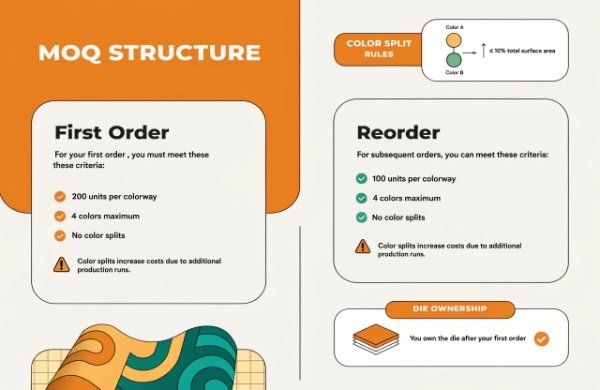
MOQ is not a single number—it is a system of constraints that controls how you can reorder, split sizes or colors, and modify designs after the first batch. If your supplier does not explain reorder minimums, color-split rules, and die ownership terms upfront, you will face unexpected inventory lockups later.
The Real MOQ Structure You Need to Understand
I have seen this scenario play out more times than I can count. A brand orders 2,000 units. The supplier says the MOQ is 2,000. Six months later, the brand wants to reorder 1,000 units because they are testing a new product line. The supplier says reorder minimum is 3,000 units per SKU.
The first MOQ was a promotional entry point. The reorder MOQ is the real constraint. This is not deceptive. It is just how manufacturing economics work. But if no one explains this before you sign, you get trapped.
Here is what you need to ask:
| Question | Why It Matters | What to Look For |
|---|---|---|
| What is the reorder minimum? | Often 50-100% higher than first-order MOQ | Get it in writing in the contract |
| Can I split colors or sizes in one order? | Most factories charge per-color minimums | Confirm if 2,000 units means 2,000 per color or total |
| Who owns the die after payment? | Die ownership affects future flexibility | Ensure you own the die and can take it elsewhere |
| What happens if I modify dimensions by 2mm? | Even small changes may require new die costs | Understand the threshold for "new tooling" |
I worked with a wellness brand that ordered custom boxes. They wanted to test three SKU sizes in one order. The supplier quoted 2,000 units total. They assumed they could split it into 700-700-600 across three sizes. Production started, and they got a call. Each size needed 2,000 units. Minimum 6,000 units total.
They had already paid the deposit. They had to absorb the cost or lose the deposit and restart with another supplier. The product launch got pushed back four months.
This was not the supplier being dishonest. This was the buyer not asking the right questions before signing.
How Do You Guarantee Color Consistency Across Production Batches?
You approve a sample. It looks perfect. The color matches your brand guidelines. You sign the PO. Four weeks later, the production batch arrives. The color is off. Not wildly different, but noticeably different under retail lighting.
Sample approval does not guarantee production consistency—batch-to-batch color matching depends on documented ΔE tolerance limits (ideally ΔE < 1), process control checkpoints, and pre-production approval workflows that most suppliers do not offer unless you explicitly require them in the contract.
Why Your Approved Sample Does Not Lock In Quality
I have had this conversation with clients at least once a month. They think an approved sample is a binding quality standard. It is not, unless the contract says so.
Most factories treat samples as "directional references." They will try to match the sample. But if there is a 10% color shift, they will ship it anyway unless you have a written rejection protocol.
The issue is not about bad intent. It is about the gap between design expectations and manufacturing tolerances. Printing presses drift. Paper batches vary. Ink formulations shift slightly between production runs.[^1]
If you do not specify the tolerance level, the factory uses their internal standard. And their standard is usually looser than your brand standard.
Here is what you need to confirm before signing:
| Question | Why It Matters | What to Look For |
|---|---|---|
| What ΔE tolerance do you guarantee? | ΔE < 1 is premium standard; ΔE < 2 is acceptable[^2]; anything above is risky | Get the number in the contract, not just verbal assurance |
| Do I approve a pre-production sample before bulk run? | This is your last checkpoint before mass production | Confirm this step is mandatory, not optional |
| What happens if the batch fails my visual inspection? | You need a clear rework or refund protocol | Ensure the contract defines rejection criteria and remedies |
| How do you control color during multi-batch orders? | Large orders split into batches can have color drift between batches | Ask about batch tracking and cross-batch matching protocols |
I worked with a cosmetics brand that launched a premium skincare line. Their brand colors were specific Pantone shades. The sample looked perfect. The first batch of 5,000 units arrived, and the color was visibly different under store lighting.
They had no rejection clause in the contract. The supplier offered a 10% discount on the next order. But the brand could not use the boxes. They had to eat the cost and reorder from another supplier. The financial hit was over $15,000, plus the delay.
The factory was not being malicious. They just used their standard ΔE < 3 tolerance, which is common in the industry. But the brand needed ΔE < 1 for their premium positioning. No one asked the question before signing.
What Is the True All-In Cost Beyond the Unit Price?
You get a quote for $2.50 per unit. You calculate your budget. You sign the PO. Then the invoices start coming. Design revision fee. Sampling round charges. Die cost amortization. Freight upcharges. Customs clearance fees.
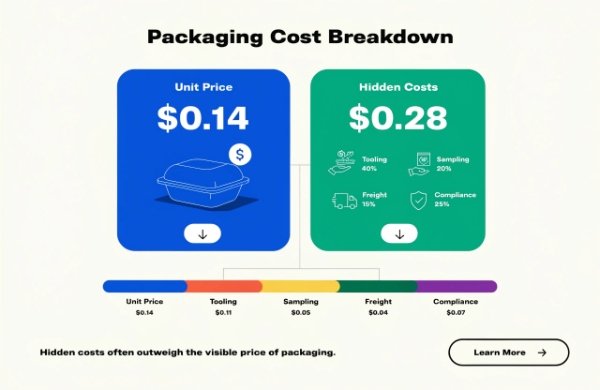
The quoted unit price rarely includes the full cost structure—design iterations, tooling amortization, sampling rounds, freight terms (FOB vs. DDP), and customs handling can add 20-40% to the final landed cost[^3] if these line items are not clarified before contract signing.
The Cost Line Items That Appear After You Sign
I have seen this pattern play out with almost every first-time buyer. They focus on the unit price. They think that is the budget. It is not.
The unit price is only one part of the cost structure. The rest of the costs show up as separate line items after the contract is signed. And if these items were not discussed upfront, you have no leverage to negotiate them.
This is not about suppliers hiding costs. It is about different cost allocation models. Some suppliers include design and sampling in the unit price. Others charge separately. Neither approach is wrong, but if you do not ask, you will not know which model you are buying into.
Here is the checklist you need to walk through:
| Cost Category | Common Hidden Items | What to Confirm Before Signing |
|---|---|---|
| Design & Artwork | Revisions beyond first round, structural modifications, file preparation | Ask how many revisions are included and the per-hour rate after that |
| Sampling | Multiple sampling rounds, shipping costs for samples, color proofing | Clarify if first sample is free and how much subsequent samples cost |
| Tooling | Die costs, plate fees, setup charges, die storage fees | Confirm if tooling is a one-time cost or amortized across orders |
| Freight & Delivery | FOB vs. DDP terms[^4], port handling, customs clearance, last-mile delivery | Get a DDP quote to see the true landed cost in your warehouse |
| Payment Terms | Deposit structures, currency conversion fees, wire transfer charges | Understand the full payment schedule and associated fees |
I worked with a wellness brand that got a quote for $1.80 per unit. They budgeted for 3,000 units at $5,400 total. When the final invoice came, the total was $7,200.
The breakdown included: $600 for die costs, $300 for three sampling rounds, $400 for design revisions, and $500 for freight upcharges because the shipment missed the original vessel. None of these items were in the original quote.
The brand owner felt blindsided. But when we reviewed the original quote, it said "FOB Shanghai" and "tooling costs additional." The supplier was not hiding anything. The buyer just did not understand what those terms meant.
Are Your Compliance Certifications Valid for My Target Markets?
You ask your supplier if they have FSC certification. They say yes. You sign the PO. Six months later, your EU distributor rejects the shipment because the FSC certificate does not cover the specific product category. Or your Australian retailer asks for EPR documentation, and your supplier has never heard of it.
Compliance certifications are not universal—FSC/GRS validity, scope coverage, and market-specific regulations (EU EPR, Australian Packaging Covenant, US state laws) must be verified before signing, not after your first shipment gets rejected at the border or by a retail partner.
 Compliance certification checklist
Why Generic Certification Claims Are Not Enough
I have had multiple clients discover compliance gaps after they signed contracts. The issue is not that suppliers lie about certifications. The issue is that buyers do not understand what the certifications actually cover.
FSC certification, for example, has different chain-of-custody scopes. A factory might be FSC-certified for corrugated boxes but not for folding cartons. If you order folding cartons and assume the FSC certificate covers it, you will find out too late that it does not.
GRS certification is similar. It certifies recycled content traceability, but it does not automatically mean the material is compostable or meets specific market biodegradability standards.
And then there are market-specific regulations that have nothing to do with material certifications. EU Extended Producer Responsibility (EPR) requires brands to register and report packaging waste data[^5]. Australian Packaging Covenant requires participation in a recovery scheme[^6]. US states like California and Maine have their own packaging producer laws.
Your supplier might have all the material certifications, but if they do not understand your market compliance requirements, you will face regulatory penalties or shipment rejections after you have already paid for production.
Here is what you need to verify:
| Compliance Area | Questions to Ask | What to Request as Proof |
|---|---|---|
| Material Certifications | Is your FSC/GRS certificate valid for this specific product category? | Request the certificate and verify scope with the issuing body |
| Recycled Content | What percentage of recycled material is used, and is it post-consumer or post-industrial[^7]? | Ask for third-party lab test reports, not just supplier claims |
| Market-Specific Regulations | Do you understand EU EPR, Australian Packaging Covenant, or US state EPR laws? | Ask if they have shipped to your target market before and can provide compliance documentation |
| Heavy Metal & Chemical Compliance | Does the packaging meet EU REACH[^8], California Prop 65[^9], and heavy metal limits[^10]? | Request test reports for lead, cadmium, and phthalates |
I worked with a skincare brand launching in the EU. They ordered custom boxes from a supplier who claimed to be fully compliant. The boxes arrived, and the brand registered for EPR in France. The French authorities asked for material composition data and recycled content verification. The supplier could not provide it.
The brand had to halt sales until they sourced compliant packaging from another supplier. They lost three months of revenue and paid duplicate tooling costs.
The original supplier was not trying to deceive them. They just did not understand EU EPR requirements because they had never shipped to Europe before. The brand assumed "FSC-certified" meant "EU-compliant." It did not.
Conclusion
The questions you ask before signing your first PO determine whether your packaging partnership supports your growth or becomes a source of delays, cost overruns, and compliance headaches. Verify the full MOQ structure, demand written color consistency standards, calculate the true all-in cost, and confirm market-specific compliance before you commit.
[^1]: "Color Consistency Issues in Print Production: Factors to Consider", https://www.linkedin.com/posts/jeremynewns_graphicdesign-printproduction-pantone-activity-7414350109452197888-ws1B. Color consistency in printing is affected by multiple variables including press mechanical tolerances, substrate characteristics (paper brightness, texture, absorbency), ink rheology and pigment dispersion, environmental conditions (temperature, humidity), and operator adjustments, requiring process control measures to maintain color within specified tolerances across production runs. Evidence role: mechanism; source type: research. Supports: technical factors that contribute to color variation in commercial printing. Scope note: The relative contribution of each factor varies by printing technology and production environment
[^2]: "[PDF] An Investigation of Factors Influencing Color Tolerances", https://repository.rit.edu/cgi/viewcontent.cgi?article=1874&context=other. Delta E (ΔE) is a metric for understanding color difference in the CIE color space, where values below 1.0 represent color differences imperceptible to most observers, while values between 1.0-2.0 indicate perceptible but acceptable differences in commercial printing applications. Evidence role: definition; source type: research. Supports: technical definition of ΔE measurement and industry-accepted tolerance ranges for color matching. Scope note: Acceptable tolerance ranges may vary by industry segment and application context
[^3]: "Understanding Landed Cost Components & Calculations - LinkedIn", https://www.linkedin.com/pulse/understanding-landed-cost-components-calculations-hidden-6uppc. Supply chain research indicates that landed costs in international procurement commonly exceed quoted unit prices by 15-45% when accounting for tooling, freight, customs, and ancillary fees, with variation depending on product complexity and shipping terms. Evidence role: statistic; source type: research. Supports: typical percentage ranges for additional costs beyond quoted unit prices in international manufacturing procurement. Scope note: Percentage ranges vary significantly based on product category, origin country, and incoterms
[^4]: "Know Your Incoterms - International Trade Administration", https://www.trade.gov/know-your-incoterms. Under Incoterms 2020, FOB (Free on Board) requires the seller to deliver goods on board the vessel at the named port of shipment, with the buyer responsible for freight and insurance thereafter, while DDP (Delivered Duty Paid) requires the seller to deliver goods to the buyer's premises with all costs including freight, insurance, and import duties paid by the seller. Evidence role: definition; source type: institution. Supports: definitions of FOB and DDP trade terms and their cost implications.
[^5]: "Packaging and packaging waste directive - Wikipedia", https://en.wikipedia.org/wiki/Packaging_and_packaging_waste_directive. The EU Packaging and Packaging Waste Directive (94/62/EC, as amended) establishes Extended Producer Responsibility schemes requiring producers to take responsibility for the collection, sorting, and recycling of packaging waste, with implementation varying by member state. Evidence role: general_support; source type: government. Supports: legal framework establishing producer responsibility obligations for packaging in EU member states. Scope note: Specific registration and reporting requirements differ across EU member states
[^6]: "APCO", https://apco.org.au/. The Australian Packaging Covenant (now administered by APCO - Australian Packaging Covenant Organisation) is a co-regulatory arrangement under the National Environment Protection (Used Packaging Materials) Measure that requires brand owners and importers to participate in packaging waste reduction and recovery initiatives. Evidence role: general_support; source type: government. Supports: regulatory framework for packaging stewardship in Australia. Scope note: Requirements have evolved with recent regulatory changes including mandatory reporting obligations
[^7]: "Regulatory Exclusions and Alternative Standards for the Recycling ...", https://www.epa.gov/hw/regulatory-exclusions-and-alternative-standards-recycling-materials-solid-wastes-and-hazardous. Post-consumer recycled content refers to material generated by end-use consumers that has completed its intended use, while post-industrial (or pre-consumer) recycled content consists of manufacturing waste diverted from the waste stream during production, with post-consumer content generally considered more environmentally valuable as defined in standards such as ISO 14021. Evidence role: definition; source type: research. Supports: technical definitions distinguishing post-consumer from post-industrial recycled content.
[^8]: "Registration, Evaluation, Authorisation and Restriction of Chemicals", https://en.wikipedia.org/wiki/Registration,_Evaluation,_Authorisation_and_Restriction_of_Chemicals. REACH (Registration, Evaluation, Authorisation and Restriction of Chemicals, Regulation EC 1907/2006) is the EU's framework for managing chemical substances, requiring registration of chemicals and restricting or banning hazardous substances, with implications for packaging materials that may contain regulated chemicals. Evidence role: general_support; source type: government. Supports: regulatory framework governing chemical substances in products sold in the EU. Scope note: REACH primarily regulates chemical substances themselves rather than finished packaging products
[^9]: "Frequently Asked Questions for Businesses - P65Warnings.ca.gov", https://www.p65warnings.ca.gov/business-resources/frequently-asked-questions-businesses. California's Safe Drinking Water and Toxic Enforcement Act of 1986 (Proposition 65) requires businesses to provide warnings before exposing individuals to chemicals known to cause cancer or reproductive harm, with a list of over 900 chemicals that may be present in packaging materials, inks, or coatings. Evidence role: general_support; source type: government. Supports: California law requiring warnings for products containing certain chemicals. Scope note: Prop 65 is a warning requirement rather than a ban on substances
[^10]: "Toxics in Packaging | Department of Toxic Substances Control", https://dtsc.ca.gov/toxics-in-products/toxics-in-packaging/. The EU Packaging and Packaging Waste Directive (94/62/EC) limits the sum of lead, cadmium, mercury, and hexavalent chromium in packaging to 100 ppm by weight, a standard that has been adopted or referenced by numerous jurisdictions including many U.S. states through the Toxics in Packaging Clearinghouse model legislation. Evidence role: statistic; source type: government. Supports: regulatory limits on heavy metal concentrations in packaging materials.